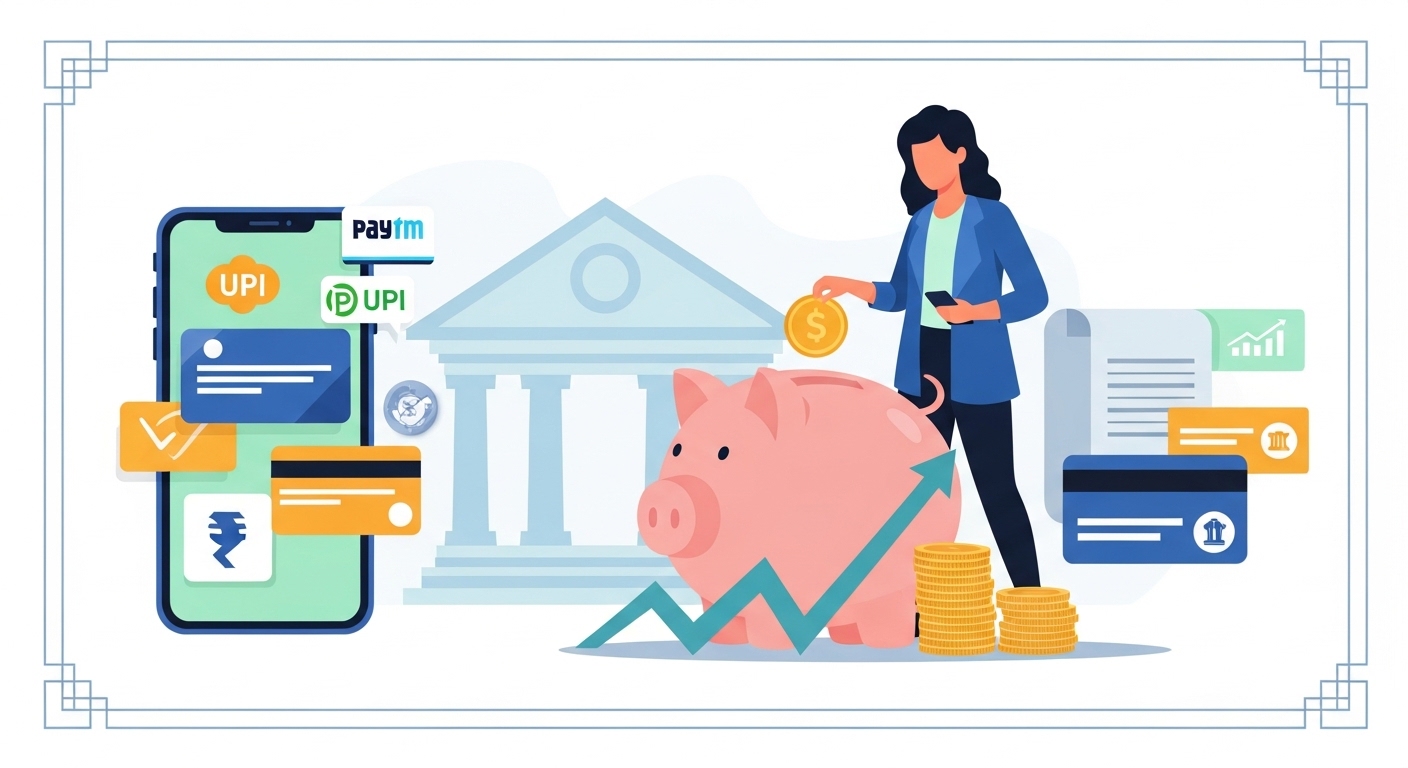
New banking guidelines in 2026 are making it simpler to open and manage your accounts. Yet, many people still misunderstand the basic differences between a checking and a savings account, leading to common financial missteps. This often results in losing out on interest or struggling with daily expenses.
This guide will help you avoid those common mistakes by clearly explaining each account type and how they fit your unique financial goals. You’ll learn how to best use both accounts to keep your money safe, accessible, and growing effectively. Here you will find practical advice to make your best choice today.
Table of Contents
What Is a Bank Account?
A bank account is a financial arrangement with a bank or other financial institution, regulated by the Reserve Bank of India (RBI), allowing you to deposit and withdraw money. It provides a secure place for your funds, helping you manage daily expenses and save for the future.
For instance, a Post Office Savings Account, offered by India Post, requires a minimum initial deposit of ₹500, according to India Post (2026). Without a proper bank account, you might struggle with digital payments, receiving government benefits, or securing your savings from risks like theft.
To open an account, visit your preferred bank’s branch or their official online portal.
What Are Bank Accounts And Why Do They Matter?
Understanding bank accounts is foundational to managing your money well. They’re not places to keep cash; they are tools that help you achieve financial stability and growth. Many people make the mistake of seeing them as a single entity, missing their distinct purposes.
Think about it: your money needs different homes depending on what you want it to do. Knowing the right home for each rupee can prevent common errors like overspending or missing out on potential earnings. It’s about making your money work smarter for you.
Keep your money safe
One primary reason for having a bank account is security. Keeping large amounts of cash at home can be risky, making you vulnerable to theft or loss. Banks offer a secure environment, protecting your funds from such unfortunate events.
Your money in a bank is also insured, providing an extra layer of protection. This means even if something unexpected happens to the bank, your deposits are safe up to a certain limit as per official RBI guidelines. Don’t underestimate the peace of mind this brings.
Quick Context: Deposit Insurance
In India, deposits in commercial banks, regional rural banks, local area banks, and co-operative banks are insured by the Deposit Insurance and Credit Guarantee Corporation (DICGC). This provides cover up to as per the latest official guidelines per depositor for both principal and interest amounts.
Manage your daily finances
Bank accounts simplify your everyday financial tasks significantly. You can easily pay bills, receive your salary, and make purchases without needing physical cash. This convenience is a cornerstone of modern financial life.
Using digital payment methods linked to your account, like UPI, makes transactions instant and traceable. This helps you keep a clear record of where your money goes, which is vital for budgeting. Many people overlook the power of digital records for financial planning.
Grow your money over time
Beyond safety and convenience, certain bank accounts help your money grow. Savings accounts, for example, earn interest on your deposits. This means your money slowly increases by sitting in the account.
While the interest rates might seem small, over time, this growth can add up significantly. Choosing the right account for your savings goals is crucial to maximising these returns. It’s a common mistake to leave idle funds in a checking account that earns little to no interest.
Understanding Your Checking Account
A checking account, often called a current account, is designed for your daily financial transactions. It’s the hub for your regular income and expenses. Many people mistakenly use their checking account for long-term savings, which isn’t its primary purpose.
This type of account offers high liquidity, meaning you can open your money easily and frequently. It’s built for movement, not for holding large sums that you don’t plan to spend soon. Understanding this distinction avoids common financial pitfalls.
What is a checking account?
A checking account is a transactional account that allows you to deposit and withdraw money freely. It’s ideal for managing your day-to-day cash flow. You’ll typically use it for receiving your salary, paying bills, and making purchases.
These accounts usually come with facilities like debit cards, cheque books, and online banking open. They are designed for convenience and constant activity. Think of it as your financial command centre for daily operations.
For everyday spending
Your checking account is perfect for all your routine expenses. Whether it’s buying groceries, paying for transport, or enjoying a meal out, your debit card or UPI is linked directly to these funds. This makes everyday transactions quick and simple.
It helps keep your spending organised, as all your daily debits and credits are recorded in one place. Many people mix their spending and saving money, making it hard to track where their cash goes. A dedicated checking account solves this.
Easy open to money
Accessing your money from a checking account is incredibly easy. You can use ATMs, online banking, mobile banking apps, or even issue cheques. This high level of accessibility is its main advantage.
This ease of open means you’re never far from your funds when you need them for immediate expenses. However, this also means you need to be disciplined to avoid overspending. It’s a tool for convenience, but requires responsible use.
Paying bills and purchases
Automatic bill payments and recurring charges are typically set up from your checking account. This ensures your electricity, internet, and loan EMIs are paid on time without you needing to remember each deadline. It simplifies your financial life.
You can also link your debit card to online shopping portals for quick purchases. This makes managing your monthly outgoings much smoother. Forgetting to pay bills can lead to late fees, a common mistake easily avoided with a checking account.
Common Confusion: Style A
It is commonly assumed that a checking account is the best place for all your money.
While convenient for daily use, a checking account typically offers very low or no interest, meaning your savings won’t grow effectively here.
Common features explained
Checking accounts come with several standard features designed for convenience. These include a debit card for transactions, a cheque book for larger payments or withdrawals, and internet banking open. You’ll also get SMS alerts for transactions.
Most banks also offer mobile banking apps, allowing you to manage your account on the go. These features are essential for modern financial management. They help you to control your money from almost anywhere.
- Debit Card: Used for purchases and ATM withdrawals.
- Cheque Book: For making payments or withdrawals when a digital option isn’t suitable.
- Online & Mobile Banking: open your account, pay bills, and transfer funds electronically.
- UPI Facility: Instant payments and transfers directly from your account.
Benefits of a checking account
The main benefit is unparalleled convenience for daily transactions. You can manage all your regular income and expenses from one central place. This makes budgeting and tracking much simpler.
It also provides a secure alternative to carrying cash, reducing the risk of theft. Having a checking account is almost a necessity in today’s digital economy. It’s your gateway to modern financial services.
Pro Tip: Set up transaction alerts
Enable SMS and email alerts for all transactions on your checking account. This helps you monitor your spending and quickly spot any unauthorised activity, preventing potential fraud.
Things to consider
While highly convenient, checking accounts often offer very little or no interest on your balance. This means your money isn’t growing while it sits there. This is a crucial point many people overlook.
Some checking accounts might also have minimum balance requirements or monthly maintenance fees if you fall below a certain threshold. Always check these terms with your bank to avoid unexpected charges. A common mistake is not reading the fine print.
Exploring Your Savings Account
A savings account is specifically designed to help you save money and earn interest on it. Unlike a checking account, it’s not meant for frequent transactions. It’s the ideal place for money you want to keep for future goals.
Think of it as a long-term home for your funds, where they can grow steadily over time. Many people make the mistake of keeping their emergency fund in a checking account, where it’s too easily spent. A savings account provides a clear boundary.
What is a savings account?
A savings account is a deposit account held at a bank or other financial institution that pays interest on your balance. Its primary purpose is to encourage saving money. You can deposit funds and make withdrawals, but usually with some limitations compared to a checking account.
These accounts are perfect for money you don’t need to open daily. They offer a secure way to build your financial reserves. The interest earned, even if modest, helps your money increase passively.
For future financial goals
Whether you’re saving for a down payment on a home, your child’s education, or a new car, a savings account is the right tool. It segregates these funds from your everyday spending money. This separation helps you stay disciplined.
Having a dedicated savings account for specific goals makes it easier to track your progress. It’s a common psychological trick that helps you commit to your financial objectives. Don’t let your savings get mixed up with daily expenses.
Earning interest on savings
One of the biggest advantages of a savings account is the interest it earns. The bank pays you a percentage of your balance for keeping your money with them. This is how your money grows passively.
While interest rates vary between banks and types of savings accounts, even a small percentage can add up significantly over years. For example, a Public Provident Fund (PPF) account, a popular government-backed savings scheme, offers a competitive interest rate, as per India Post (2026). This compounding effect is a powerful way to build wealth.
| Savings Scheme | Key Feature | Interest Rate (as of 2026) |
| Public Provident Fund (PPF) | Long-term savings with tax benefits | As per India Post (2026) |
| National Savings Certificate (NSC) | Fixed-term investment, tax benefits | As per India Post (2026) |
| Sukanya Samriddhi Yojana (SSY) | Girl child savings scheme | As per India Post (2026) |
Building your emergency fund
An emergency fund is crucial for financial security, and a savings account is the ideal place for it. This fund should cover 3-as per the latest official guidelines of your living expenses, ready for unexpected events like job loss or medical emergencies. Keeping it separate ensures it’s available when truly needed.
Many people make the mistake of not having an emergency fund, or keeping it in an easily accessible checking account. A savings account provides a slight barrier to impulsive spending, protecting your safety net. It’s a smart financial habit.
Common Confusion: Style C
The misunderstanding here is that all bank accounts offer the same interest rates.
Interest rates vary significantly between checking and savings accounts, and even among different types of savings schemes. Always compare to find the best rate for your goals.
Common features explained
Savings accounts also come with essential features, though often with more restrictions than checking accounts. You’ll typically get a passbook, a debit card (sometimes with withdrawal limits), and online banking open. The focus is on tracking your savings and making occasional withdrawals.
Some savings accounts might offer higher interest rates for higher balances or specific tenure periods. It’s important to understand these nuances to maximise your earnings. Don’t pick the first account you see.
- Passbook: A physical record of all your transactions and balance.
- Debit Card: For withdrawals and sometimes limited purchases.
- Online & Mobile Banking: To view statements and transfer funds.
- Interest Earnings: Your money grows over time.
Benefits of a savings account
The primary benefit is earning interest, which allows your money to grow passively. It also helps you separate your long-term savings from your daily spending, promoting financial discipline. This clear distinction prevents accidental overspending.
Savings accounts provide a secure place for your funds, often with deposit insurance. They are an excellent tool for achieving specific financial goals and building an emergency fund. It’s a cornerstone of responsible financial planning.
Pro Tip: Automate your savings
Set up an automatic transfer from your checking account to your savings account each month. Even a small, consistent amount can build up significantly over time, making saving easily.
Things to consider
While beneficial, savings accounts might have withdrawal limits or penalties for excessive transactions. Banks want to encourage saving, not constant spending from these accounts. Always check the specific terms and conditions.
Interest rates can also change, so it’s wise to review them periodically. Some accounts might require a minimum balance to earn interest or avoid fees. Be aware of these conditions to avoid surprises.
Key Differences Between Accounts
Understanding the fundamental differences between checking and savings accounts is crucial for smart money management. Many people make the mistake of treating them interchangeably, which can lead to missed opportunities or financial stress. Each account has a distinct role to play in your financial strategy.
Think of it like different tools in a toolbox; you wouldn’t use a hammer for every job. Similarly, you need the right account for the right financial task. Knowing these distinctions helps you avoid common pitfalls.
Purpose of each account
The most significant difference lies in their primary purpose. A checking account is for managing your everyday transactions and expenses. It’s designed for high activity and easy open to funds.
A savings account, however, is for accumulating funds over time and earning interest. It’s meant for money you don’t need immediately, focusing on growth and long-term goals. This fundamental difference guides all other features.
Accessing your money
open to funds varies greatly. Checking accounts offer immediate and frequent open through debit cards, UPI, cheques, and online transfers. There are generally no limits on how often you can withdraw or spend.
Savings accounts, conversely, often have restrictions on the number of free withdrawals you can make per month. Exceeding these limits might incur fees. This encourages you to think twice before dipping into your savings.
Earning potential
This is where savings accounts truly shine. They offer interest on your deposited money, allowing your balance to grow over time. The interest rates can vary, but the principle remains the same: your money works for you.
Checking accounts typically offer very low or no interest. Keeping large sums of money in a checking account for extended periods means you’re missing out on potential earnings. This is a common and costly mistake.
Common Confusion: Style D
A savings account is a checking account with fewer features.
A savings account’s core function is to generate interest on your deposits, a feature largely absent from checking accounts, making their purposes fundamentally different.
Transaction limits
Checking accounts generally have high daily transaction limits for debit card usage and UPI payments, as per official RBI/NPCI guidelines (2026). They are built for volume. This allows you to handle all your daily financial needs without hindrance.
Savings accounts, on the other hand, might have limits on the number of withdrawals or transfers you can make in a month. These limits are in place to encourage saving rather than constant spending. Be mindful of these to avoid unexpected fees.
Which Account Is Best For Your Goals?
Choosing the right account depends entirely on your financial goals. Many people make the mistake of using a single account for everything, which can hinder both their daily budgeting and their long-term savings. You need a designed approach.
Think about what each rupee is meant to do. Is it for immediate spending, a short-term goal, or building long-term wealth? Matching your accounts to these needs is key to financial success.
For your daily spending
For your everyday transactions, a checking account is undoubtedly the best choice. It provides the necessary tools like debit cards and UPI for smooth payments. You won’t face restrictions on how often you open your funds.
Using your checking account for daily expenses ensures your savings remain untouched. This separation helps you budget effectively and avoid common overspending mistakes. It’s your financial workhorse.
For your short-term goals
If you’re saving for something in the next 1-3 years, like a new gadget, a holiday, or a down payment on a vehicle, a regular savings account is a good option. It earns interest, helping your money grow faster than in a checking account. It keeps these funds separate from your daily cash.
Consider options like the Post Office Savings Account, which offers a secure way to save with a decent interest rate, as per India Post (2026). This dedicated account helps you stay focused on your goal.
For your long-term goals
For goals spanning several years, such as your child’s education, retirement, or buying a home, you should look beyond a basic savings account. Schemes like the Public Provident Fund (PPF), National Savings Certificate (NSC), or Sukanya Samriddhi Yojana (SSY) offer higher interest rates and tax benefits. These are specifically designed for long-term wealth creation.
For retirement, the National Pension System (NPS) is an excellent option, allowing you to build a pension corpus over time, according to NPS (2026). These options help you grow your money much more significantly than a standard savings account. Don’t make the mistake of missing out on these powerful tools.
Building an emergency fund
An emergency fund needs to be accessible but not too easily spent. A standard savings account is ideal here. It earns some interest, keeping your money growing, but the slight barrier to open helps prevent impulsive spending.
Aim to save at least three to six months’ worth of living expenses in this account. This fund acts as your financial safety net, protecting you from unexpected life events. It’s one of the most important financial habits you can cultivate.
Matching accounts to needs
Here’s a simple way to match your accounts to your needs:
- Daily Expenses: Use a checking account.
- Emergency Fund: Use a savings account.
- Short-Term Savings (1-3 years): Use a savings account or short-term fixed deposits.
- Long-Term Savings (3+ years): Explore PPF, NSC, SSY, or NPS for better returns and tax benefits.
Can You Have Both A Checking And Savings Account?
, and in fact, having both a checking and a savings account is the smartest financial strategy for most people. Many individuals make the mistake of thinking they only need one type of account, limiting their financial flexibility and growth. Combining them allows you to manage different aspects of your money effectively.
This dual approach ensures your daily needs are met while your future goals are actively pursued. It’s about creating a balanced financial ecosystem. You’ll find that they complement each other perfectly.
Benefits of having both
The biggest benefit is clear financial segregation. Your daily spending money is separate from your savings, making it much easier to budget and prevent overspending. This helps you avoid dipping into funds meant for future goals.
You get the best of both worlds: the high liquidity and convenience of a checking account for everyday life, combined with the interest-earning potential and financial discipline of a savings account. This strategy minimises common financial errors.
How they work together
Think of your checking account as your income’s arrival point and your spending hub. Your salary comes in here, and your bills are paid from it. Then, a portion of your income can be automatically transferred to your savings account.
This automatic transfer is a powerful habit for building wealth. It ensures you “pay yourself first” before you even have a chance to spend the money. Your savings account then grows quietly, ready for your goals or emergencies.
Pro Tip: Use automatic transfers
Set up a standing instruction for a fixed amount to move from your checking to your savings account on your payday. This simple automation is a cornerstone of effective saving.
Managing multiple accounts
Managing multiple accounts is simpler than you might think, especially with modern online banking. Most banks allow you to view and manage all your accounts from a single dashboard. This provides a complete view of your finances.
Regularly review your statements for both accounts to track your spending and saving progress. This oversight helps you identify areas where you can improve and ensures you’re on track for your financial objectives. Don’t let the idea of “too many accounts” deter you from smart financial planning.
Making Your Best Choice Today
Making the right choice for your bank accounts is a crucial step towards financial well-being. It’s about aligning your financial tools with your lifestyle and aspirations. Don’t make the common mistake of delaying this decision or choosing an account without proper consideration.
This isn’t a one-time decision; your financial needs might change over time. Regularly reviewing your accounts ensures they continue to serve you best. Take action now to set yourself up for success.
Review your financial needs
Start by honestly assessing your current financial situation and future goals. How much do you spend daily?
How much can you realistically save each month? What are your short-term and long-term financial aspirations?
Understanding these factors will guide you toward the most suitable account types and features. This self-assessment is the first and most important step in making an informed decision. Don’t skip this crucial stage.
Step 1: List your average monthly income and essential expenses. This helps you identify how much money you need for daily operations and how much is available for saving.
Step 2: Define your short-term (under 3 years) and long-term (over 3 years) financial goals. Knowing what you’re saving for helps you choose the right savings vehicle.
Step 3: Check your current banking habits, including how often you withdraw cash or make digital payments. This indicates whether a checking account with high transaction limits is essential for you.
Talk to your bank
Once you have a clear idea of your needs, speak to a representative at your preferred bank. They can explain the different types of checking and savings accounts they offer, including their features, interest rates, and any associated fees. Don’t hesitate to ask questions.
Enquire about minimum balance requirements, transaction limits, and any special schemes that might benefit you. Comparing options from different banks can also ensure you get the best deal. This proactive step can save you money and headaches later.
Common Confusion: Style F
“Do I really need both accounts if I can do everything from one?”
While one account might seem simpler, having both a checking and a savings account is generally more effective for managing daily expenses and growing long-term savings simultaneously.
Start your financial journey
The most important step is to take action. Open the accounts that align with your goals and start using them as intended. Set up those automatic transfers and begin building your emergency fund.
Your financial journey is a marathon, not a sprint. Consistent, smart choices today will lead to significant benefits in the future. You’ve got this.
Conclusion
Choosing between a checking and a savings account isn’t about picking one over the other; it’s about using both strategically. By dedicating your checking account to daily expenses and your savings account to future goals, you avoid common financial mistakes and maximise your money’s potential. Setting up automatic transfers, for example, ensures your emergency fund grows steadily, giving you invaluable peace of mind.
What is the main difference between a checking account and a savings account in India?
How can I use a savings account to build an emergency fund effectively?
Can I have both a checking account and a savings account with the same bank in India?
Why should I choose a savings account over a checking account for my long-term financial goals?
What are the potential downsides of using only a checking account for all my financial needs?
Is my money safe in a bank account in India, and what protections are in place?
What if I frequently exceed the withdrawal limits on my savings account? How can I manage this?
Which account type is better for managing daily expenses and ensuring timely bill payments?
Author
