


Form 16A is a vital document for taxpayers, as it enables accurate tax calculations and smooth filing of income tax returns (ITR). This certificate is provided by the deductor (the entity that deducts tax at source) for non-salary income. It’s crucial to retain a copy of this document for tax filing and future inquiries. In this blog, we will demystify Form 16A and equip you with all the essential information. Whether you receive income from interest, rent, professional fees, or other sources where TDS has been deducted, understanding Form 16A is indispensable for precise tax management and hassle-free ITR filing.
What is Form 16A?
Form 16A, also known as a TDS certificate, is a document issued by a deductor (the person or entity deducting tax at source) to a deductee (the person whose tax has been deducted). This certificate details the amount of tax deducted on non-salary income, such as interest income from fixed deposits, rent, professional fees, or commission. It serves as official proof that the specified amount of tax has been deducted and duly remitted to the government. Form 16A is essential for accurately calculating your tax liability and filing your income tax returns (ITR). Deductors typically issue Form 16A annually, or upon specific request, to help you with future tax inquiries and return filing.
Form 16A TDS Certificate Format
The format of Form 16A typically includes the following information:
- Name and address of the deductor
- Name and address of the deductee (employee)
- Permanent Account Number (PAN) of the deductor and deductee
- Unique TDS certificate number
- Assessment year for which the certificate is issued
- Period for which the certificate is issued
- Summary of TDS deducted and deposited
- Details of income subject to TDS, such as salary, interest, etc.
- TDS challan details, including BSR code, date of deposit, and challan identification number
- Any other relevant information or disclosures
It’s important to note that the exact format may vary slightly based on updates and changes made by the Income Tax Department. Deductors are responsible for ensuring that the information provided in Form 16A is accurate and matches the details reported to the tax authorities.
Here is an example format of Form 16A TDS Certificate:
[Logo/Name/Address of the Deductor]
Form No. 16A
(TDS Certificate under Section 203 of the Income Tax Act, 1961)
[Deductor’s TAN (Tax Deduction and Collection Account Number)]
[PAN (Permanent Account Number) of the Deductor]
[PAN (Permanent Account Number) of the Deductee]
Name and Address of the Deductor:
[Deductor’s Name]
[Deductor’s Address]
Name and Address of the Deductee:
[Employee’s Name]
[Employee’s Address]
Assessment Year:
[Year for which the TDS is being reported]
Period:
[Duration for which the TDS is being reported]
Particulars of Payment:
[Details of payment on which TDS is deducted, such as salary, interest, etc.]
Receipt Numbers:
[Receipt numbers of TDS returns filed]
Details of Tax Deducted and Deposited:
Sl. No. Date of Payment Amount Paid/Credited Date of Deduction Amount Deducted Date of Deposit Amount Deposited Challan Details
Total Tax Deducted:
[Total amount of tax deducted]
Total Tax Deposited:
[Total amount of tax deposited]
Verification:
I, [Name of the Deductor], hereby certify that the information provided in this certificate is true and correct based on the records maintained by the deductor.
Date:
[Date of issuing the TDS certificate]
Place:
[Place of issuing the TDS certificate]
Signature:
[Signature of the Deductor or Authorized Signatory]
Designation:
[Designation of the Deductor or Authorized Signatory]
Note: This is just an example format. The actual format of Form 16A may vary depending on the requirements and guidelines issued by the Income Tax Department.
Types of Payments for Which Form 16A Is Issued
Form 16A is issued for various types of payments on which tax is deducted at source (TDS). Some common types of payments for which Form 16A is issued include:
| Type of Payment | Description |
|---|---|
| Interest on Fixed Deposits | Issued by banks/financial institutions for TDS on interest income. |
| Rent | Issued by the deductor (payer of rent) to the recipient (landlord) for TDS on rent payments. |
| Commission/ Brokerage | Issued by the payer for TDS on commission or brokerage income. |
| Professional Fees | Issued by the payer for TDS on professional fees. |
| Winnings from Lotteries, etc. | Issued for TDS on winnings from lotteries, crossword puzzles, etc. |
Note: The table provides a general overview, and there may be additional types of payments for which Form 16A is issued, depending on specific tax regulations and requirements.
Also Read: Guide to Understanding Form 16
Significance of TDS or Form 16A
The Form 16A TDS certificate holds significant importance for both the deductor (the entity deducting tax) and the deductee (the individual whose tax is deducted). Here are some key reasons why the Form 16A TDS certificate is significant:
- Proof of TDS Deduction: Form 16A acts as proof that tax has been deducted from the deductee’s income at the source.
- Income Tax Filing: Form 16A is essential for individuals when filing their income tax returns. It helps in accurately calculating their tax liability.
- Claiming Tax Credits: The TDS certificate allows individuals to claim tax credits for the tax deducted at source, reducing their overall tax liability.
- Compliance with Tax Regulations: Issuing Form 16A is mandatory for deductors (tax-deducting entities) as per the Income Tax Act. It ensures that deductors fulfill their obligations to deduct TDS and provide the necessary documentation to deductees.
- Financial Record Keeping: Form 16A helps individuals maintain accurate financial records by providing a summary of TDS deductions made by the deductor. This promotes transparency and proper record-keeping.
Also Read: Complete Guide to Understand Form 26AS
How to Get TDS Certificate/Form 16A?
Deductees receive Form 16A from their respective deductors. Deductors, who are responsible for issuing Form 16A, can download it from TRACES (TDS Reconciliation, Analysis and Correction Enabling System), a web-based application system. For a valid Form 16A, both the deductor’s TAN and the deductee’s PAN must be valid.
Here’s the step-by-step procedure for deductors to download Form 16A:
Step 1: Log in to the TRACES official portal using your user ID, TAN, PAN, password, and the captcha code.
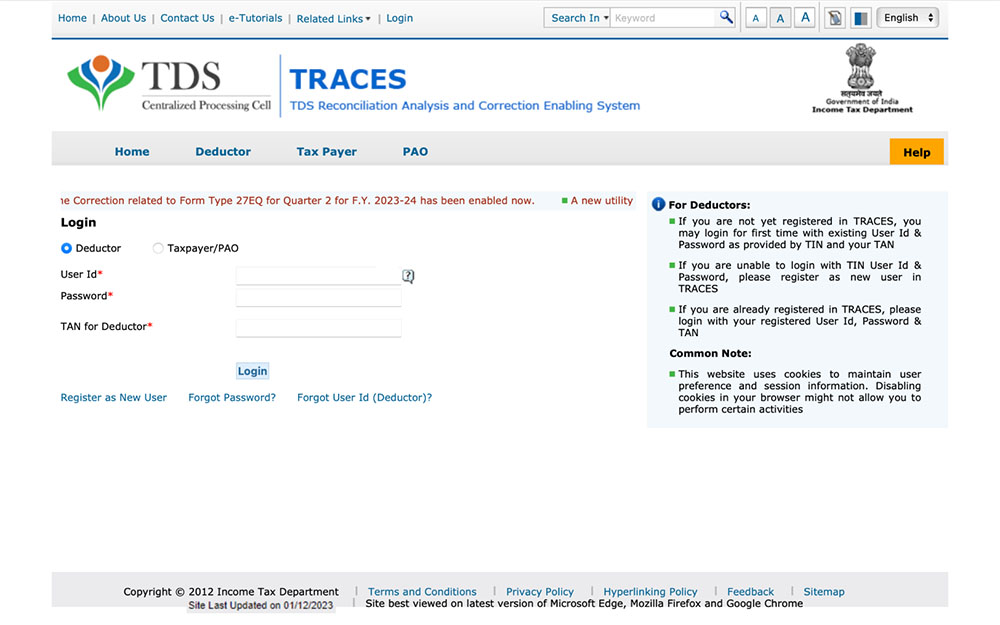
Step 2: In the ‘Downloads’ section, choose Form 16A from the dropdown menu.
Step 3: Select the financial year and quarter for which you want to download the TDS certificate, the form type, and PAN. Click on ‘Go’.
Step 4: Verify all the details displayed on the screen and in Form 16A. Click on ‘Submit’.
Step 5: There are two ways to do KYC validation:
- With DSC (Digital Signature Certificate): Click on the ‘Validate’ option, enter the DSC password, and click on ‘Sign’.
- Without DSC: Enter details such as the Token number of IT return filed, challan details, PAN, and TDS amount deposited. Click on ‘Proceed’.
Step 6: After the KYC details have been validated, a success message and a request number will appear. Wait for 24-48 hours after the request status is ‘Submitted’. Form 16A can be accessed and downloaded from the ‘Downloads’ section using the request number when the status is ‘Available’.
Step 7: Enter the request number or request date and select ‘view all’. If the status is ‘Available’, click on the download option.
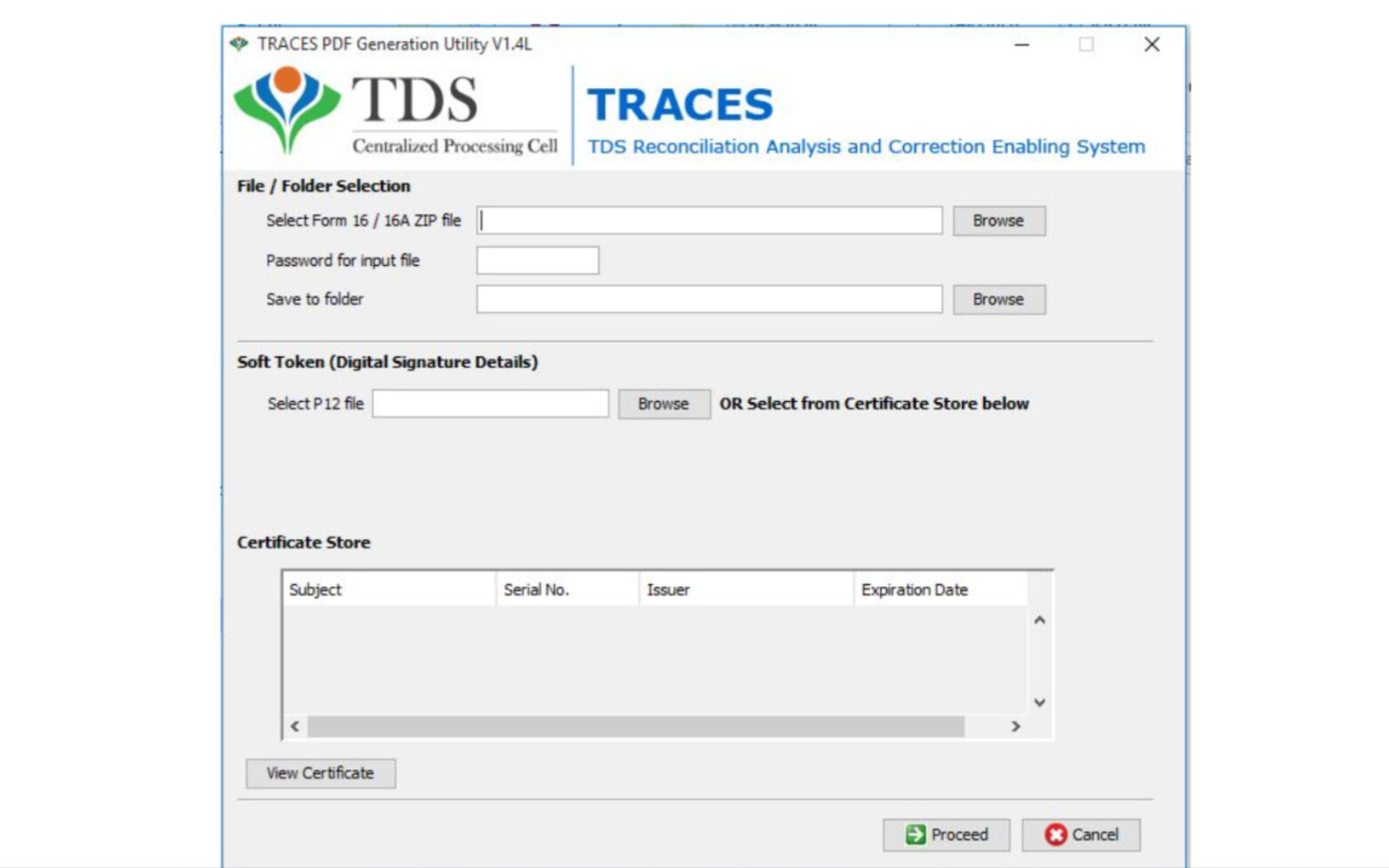
Step 8: Download the TRACES Utility to convert the text file to PDF. Go to ‘Downloads’, click on ‘Files Requested For Download’, select ‘Click Here’, and enter the captcha code on the next page.
Step 9: Download the TRACES PDF converter V 1.5 light version to convert Form 16A to PDF.
Step 10: Steps to download Form 16A PDF:
- Open the utility.
- Browse and select the zip folder.
- Enter TAN as the password for the input file.
- Select the folder where you want to save the form.
- Click on ‘Proceed’ to save the PDF version of Form 16A in the selected folder.
How to Fill Form 16A?
Step 1: Get the Form 16A format from the Income Tax Department’s website or use the format provided by the deductor’s software.
Step 2: Fill in the deductor’s details, including their name, address, PAN (Permanent Account Number), and the unique TDS certificate number.
Step 3: Provide the deductee’s information, including their name, address, PAN, and the assessment year for which the certificate is issued.
Step 4: Specify the quarter in which the TDS deduction was made, describe the nature of the payment on which TDS was deducted, and record the relevant dates.
Step 5: Enter the amount of TDS deducted and deposited with the government, along with the challan number and deposit date.
Step 6: Include any additional information or details that may be required.
Step 7: Sign and print Form 16A, and make sure to issue it to the deductee within 15 days from the due date of furnishing the TDS statement.
Also read: How to Claim TDS Refund Online?
Difference Between Form 16, Form 16A and Form 16B
| Aspect | Form 16 | Form 16A | Form 16B |
|---|---|---|---|
| Purpose | Provided by the employer to employees | Contains TDS details on non-salary income | Contains details of TDS on sale of property |
| Source | Issued by the employer | Issued by deductors other than the employer | Issued by the buyer of immovable property |
| Information | Details of salary, taxes deducted, exemptions | Details of TDS on non-salary income | Details of TDS on sale of property |
| Applicability | For salaried individuals | For income sources other than salary | For sale of immovable property |
Conclusion: Form 16A is an indispensable document for taxpayers, aiding in accurate tax calculations and streamlining the filing of income tax returns (ITR). Deductors are responsible for issuing Form 16A to deductees, providing details of tax deducted on non-salary income. It is vital to retain a copy of this document for future tax inquiries and during tax filing. A thorough understanding of Form 16A is crucial for precise tax management and hassle-free ITR filing, especially for individuals earning income from sources other than salary where TDS has been applied. Familiarizing yourself with its components, generation process (from the deductor’s perspective), and verification procedures will ensure compliance with tax regulations.
Disclaimer
This blog is written to make it easy for readers to understand complicated processes. Some information and screenshots may be outdated as government processes can change anytime without notification. However, we try our best to keep our blogs updated and relevant.
Author

