

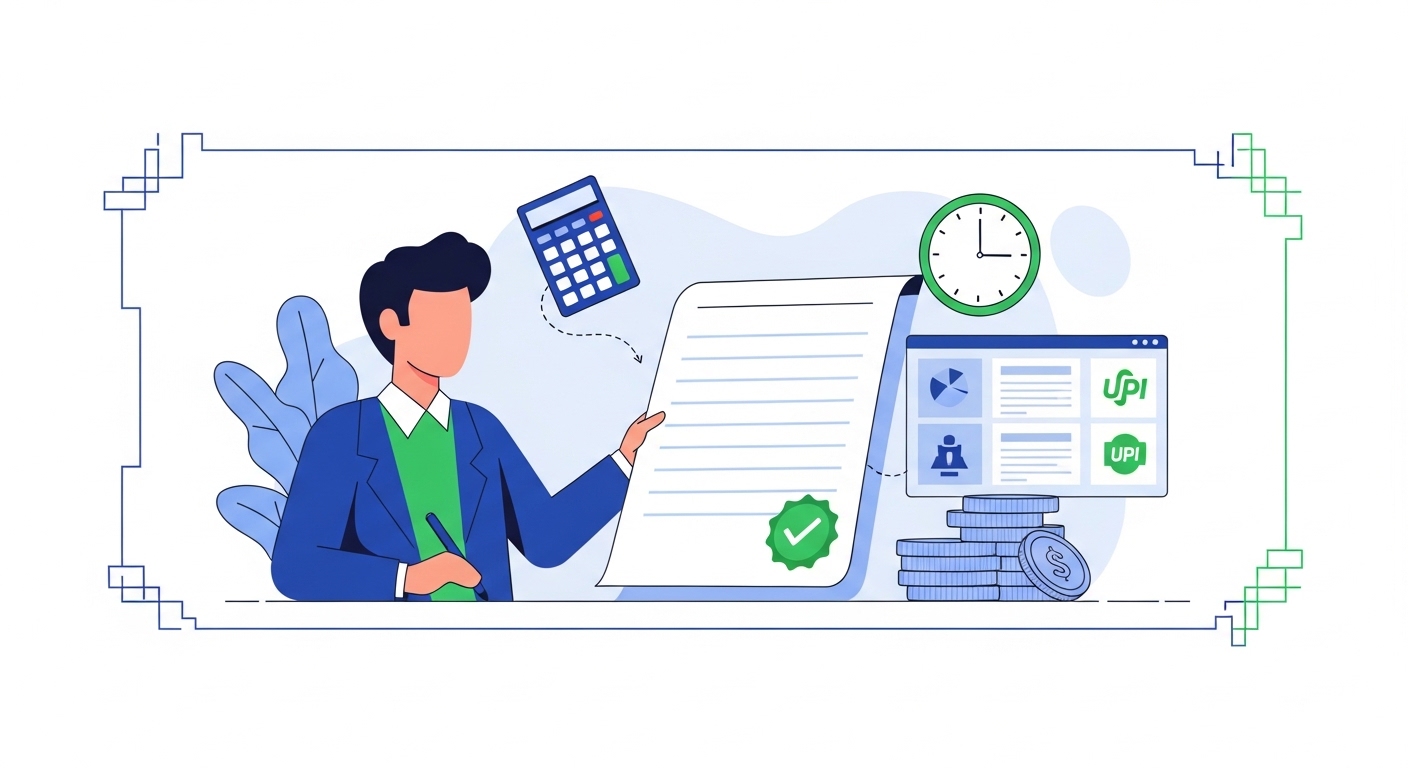
Many people believe that withdrawing money from their Employees’ Provident Fund (EPF) account is a simple, tax-free process. Actually, this isn’t always true; your withdrawal can have significant tax implications depending on how long you’ve worked and why you’re taking the money out. Understanding these rules is crucial to avoid unexpected deductions.
This guide will explain what EPF is, when you can open your funds, and, most importantly, how different withdrawal scenarios affect your taxes in 2026. You’ll find clear steps and practical advice to help you make informed decisions about your hard-earned savings.
Table of Contents
What Is EPF?
The Employees’ Provident Fund (EPF) is a mandatory savings scheme for salaried employees in India, governed by the Employees’ Provident Fund Organisation (EPFO) under the Ministry of Labour & Employment. It works by having a portion of your salary, along with a contribution from your employer, deposited into your EPF account each month, earning interest over time.
As per the latest official EPFO guidelines, the interest rate for EPF is declared annually, aiming to provide substantial returns for retirement. If you don’t understand the withdrawal rules, you could face unexpected tax deductions, reducing your take-home amount.
To manage your EPF, you should primarily use the official EPFO portal or the UMANG app.
What Is EPF and Why Is It Important for You?
The Employees’ Provident Fund (EPF) is a cornerstone of financial security for many working individuals in India. It’s designed to help you build a substantial corpus for your retirement or unforeseen circumstances. This fund ensures you have a safety net, providing peace of mind for your future.
EPF contributions are a smart way to save regularly without needing to think about it. It’s a long-term investment that grows over the years, helping you achieve your financial goals. Your EPF account is more than a savings pot; it’s a vital part of your financial planning.
Understanding Your Provident Fund
EPF is a retirement benefits scheme that requires both you and your employer to contribute a fixed percentage of your basic salary plus dearness allowance every month. This mandatory saving ensures a disciplined approach to building wealth. The EPFO manages these funds, ensuring they are invested securely and earn interest.
How EPF Helps You Save
The power of EPF lies in its compounding interest, meaning you earn interest not only on your contributions but also on the interest already earned. This growth mechanism significantly boosts your savings over the long term. Additionally, your contributions often qualify for tax benefits under Section 80C of the Income Tax Act, 1961, making it an attractive savings option.
Who Contributes to Your EPF?
Both you, as the employee, and your employer make monthly contributions to your EPF account. Typically, you contribute as per the latest official guidelines of your basic salary plus dearness allowance, and your employer contributes an equal amount. A portion of your employer’s contribution also goes towards the Employees’ Pension Scheme (EPS), providing you with a pension after retirement.
Quick Context: EPF Basics
EPF is a mandatory, government-backed retirement savings scheme where both you and your employer contribute. It offers tax benefits and grows with compound interest, providing financial security for your future.
- Mandatory Savings: Ensures regular contributions are made, building a substantial corpus over time.
- Tax Benefits: Contributions are eligible for deductions under Section 80C of the Income Tax Act, 1961, as per current regulations.
- Compound Interest: Your money grows faster because you earn interest on both your principal and accumulated interest.
- Financial Security: Provides a safety net for retirement, medical emergencies, or other significant life events.
When Can You Withdraw Your EPF Money?
Accessing your EPF funds isn’t always simple; there are specific conditions for both full and partial withdrawals. The rules are designed to ensure the fund primarily serves its purpose as a long-term retirement saving. Knowing these conditions beforehand helps you plan your financial moves effectively.
Understanding when you can withdraw also helps you avoid penalties or unexpected tax liabilities. It’s important to differentiate between situations where you can take out all your money versus only a portion. The EPFO sets these guidelines to protect your long-term financial well-being.
Conditions for Full Withdrawal
You can typically make a full withdrawal of your EPF balance in two main scenarios. The most common is upon retirement, which means reaching the age of 58. The other condition is if you face permanent unemployment, usually after two months of being out of a job and without joining a new establishment.
Reasons for Partial Withdrawal
Partial withdrawals, often called EPF advances, are permitted under several specific circumstances before retirement. These include medical emergencies, house purchase or construction, children’s education or marriage, and even for certain natural calamities. Each reason has its own set of eligibility criteria, including minimum service periods.
Important Age-Related Rules
Age plays a crucial role in EPF withdrawals. While full withdrawal is usually at 58, you can withdraw up to as per the latest official guidelines of your EPF balance one year before your retirement age (i.e., at as per the latest official guidelines old). This provision helps you plan for your pre-retirement expenses or bridge any financial gaps.
Common Confusion: A widespread myth is that you can fully withdraw your EPF balance any time you leave a job.
This is incorrect.
Full withdrawal is generally only permitted upon retirement (age 58) or after two months of continuous unemployment, provided you haven’t joined a new employer.
| Withdrawal Type | Condition | Eligibility Criteria (as per official EPFO guidelines) |
| Full Withdrawal | Retirement | Upon attaining as per the latest official guidelines of age. |
| Full Withdrawal | Unemployment | After two months of continuous unemployment (provided you remain unemployed). |
| Partial Withdrawal | Medical Emergency | Any time during service, for self or family. |
| Partial Withdrawal | Education/Marriage | After as per the latest official guidelines of service, for self/children’s education or marriage. |
| Partial Withdrawal | Home Purchase/Construction | After as per the latest official guidelines of service, for buying land/house or construction. |
Exploring Different Withdrawal Scenarios
Understanding the specific rules for each withdrawal scenario is key to a smooth process. Each reason for withdrawal comes with its own set of requirements, documentation, and sometimes, limits on the amount you can take out. You must meet these criteria to ensure your application is approved.
These scenarios are designed to provide financial relief during significant life events or emergencies. Knowing the details helps you prepare the necessary paperwork and understand the potential impact on your savings. Let’s look at the most common reasons people withdraw from their EPF.
Retirement Withdrawals Explained
When you reach as per the latest official guidelines of age, you’re eligible to withdraw your entire accumulated EPF balance, including both your and your employer’s contributions, plus the interest earned. This is considered a tax-exempt withdrawal. You’ll typically apply using Form 19 for EPF withdrawal and Form 10C for pension withdrawal.
Unemployment Withdrawal Rules
If you find yourself unemployed, you can withdraw a portion of your EPF. As per official EPFO guidelines, you can withdraw up to as per the latest official guidelines of your total EPF accumulation after one month of unemployment.
The remaining as per the latest official guidelines can be withdrawn after two months of unemployment, provided you continue to be unemployed. You’ll need to provide proof of unemployment, such as a declaration.
Medical Emergency Withdrawals
For medical emergencies, you can withdraw funds for yourself or your family members. There’s no minimum service period required for this type of advance.
You can generally withdraw up to six months of your basic wages and dearness allowance or your employee share with interest, whichever is less, as per official EPFO guidelines. You’ll need to submit medical certificates or other relevant documents.
Education and Marriage Needs
You can withdraw a portion of your EPF for your children’s education or marriage, or for your own marriage. This advance is usually available after completing seven years of service. As per official EPFO guidelines, you can withdraw up to as per the latest official guidelines of your employee’s share of contributions, including interest.
Home Purchase Withdrawals
If you’re planning to buy land, construct a house, or even repay an existing home loan, you can use your EPF. You must have completed at least five years of service to be eligible. The withdrawal limit varies but can be up to as per the latest official guidelines of the total accumulation, depending on the purpose and official EPFO guidelines.
Pro Tip: Check Your Eligibility First
Before applying for any withdrawal, always check your specific eligibility criteria and the maximum permissible amount for your chosen reason on the official EPFO portal. This prevents delays or rejections.
- Medical Emergency: Requires medical certificates from a registered doctor.
- Education: Needs proof of admission and fee structure from the educational institution.
- Marriage: Requires a copy of the wedding invitation card for yourself, your sibling, or your child.
- Home Purchase/Construction: Demands property documents, such as sale deed or construction agreements.
- Unemployment: A self-declaration stating your unemployment status is usually sufficient.
How Do EPF Withdrawals Affect Your Taxes?
The tax implications of your EPF withdrawal are perhaps the most crucial aspect to understand. Many people overlook these rules, leading to unexpected tax deductions. Your service period is the primary factor determining whether your withdrawal will be taxed or not.
It’s not about the amount you withdraw, but also the circumstances under which you withdraw it. Knowing the difference between taxable and non-taxable withdrawals can save you a significant amount of money. You’ll want to plan your withdrawal carefully to minimise your tax burden.
Taxable vs. Non-Taxable Withdrawals
The key distinction lies in the length of your service. If you withdraw your EPF balance after completing five continuous years of service, the entire amount is typically tax-exempt.
However, if you withdraw before completing five years of continuous service, the amount becomes taxable. This includes both your and your employer’s contributions, along with the accrued interest.
Understanding Tax Deducted at Source (TDS)
Tax Deducted at Source (TDS) is a mechanism where tax is deducted at the time of payment if certain conditions are met. For EPF withdrawals, if your service period is less than five years and your withdrawal amount exceeds a certain threshold, TDS will be applicable. The current threshold for TDS on EPF withdrawals, as per the Income Tax Act, 1961, is as per the latest official guidelines in 2026.
When TDS Is Applicable
TDS applies when you withdraw your EPF balance before completing five years of continuous service and the withdrawal amount is as per the latest official guidelines or more. The tax rate for TDS depends on whether your PAN is linked to your EPF account. If your PAN is not provided, a higher TDS rate will be applied.
Ways to Avoid TDS
There are several ways to avoid TDS on your EPF withdrawal. The most simple is to complete five years of continuous service before making any withdrawal.
Another method is to transfer your EPF account from your old employer to your new one, maintaining continuity of service. Additionally, you can submit Form 15G or Form 15H if your total taxable income for the year is below the basic exemption limit.
Impact on Your Income Tax
If your EPF withdrawal is taxable, the withdrawn amount will be added to your total income for the financial year in which you make the withdrawal. This could push you into a higher tax bracket, increasing your overall income tax liability. You must account for this when filing your income tax returns.
Common Confusion: The misunderstanding here is that all EPF withdrawals are subject to TDS.
This is incorrect.
TDS is only applicable if your service period is less than five years AND your withdrawal amount exceeds the specified threshold (as per the latest official guidelines in 2026).
- Service Period over as per the latest official guidelines: The entire withdrawal is tax-exempt.
- Transferring EPF: Transferring your EPF from an old employer to a new one is not considered a withdrawal and is therefore tax-free.
- Withdrawal due to Employer’s Business Closure: If your employer’s business is discontinued or closed down, your withdrawal is tax-exempt, even if you haven’t completed five years of service.
- Withdrawal Amount Below TDS Threshold: If your withdrawal is less than as per the latest official guidelines and service is less than five years, no TDS will be deducted, though the amount is still taxable.
- Submitting Form 15G/15H: If your total taxable income is below the basic exemption limit, submitting these forms can prevent TDS.
Key Tax Rules for EPF Withdrawals
Navigating the specific tax rules for EPF withdrawals requires careful attention to detail. The duration of your employment plays the most significant role in determining your tax liability. It’s essential to understand how different scenarios impact the taxability of your funds.
These rules are in place to encourage long-term savings and discourage premature withdrawals. By understanding them, you can make strategic decisions that protect your savings from unnecessary taxation. Let’s look at the specifics of these rules.
Less Than Five Years Service
If you withdraw your EPF balance before completing five continuous years of service, the entire accumulated amount becomes taxable. This includes the employer’s contribution, the employee’s contribution, and all the interest earned on both. This amount is added to your income for the year and taxed according to your applicable income tax slab.
More Than Five Years Service
When you complete five or more years of continuous service, your EPF withdrawal becomes completely tax-exempt. This is a significant benefit, as it means you won’t pay any tax on the principal or interest accumulated over this period. This rule strongly encourages you to maintain your EPF account for the long term.
Transferring Your EPF Account
Transferring your EPF account from an old employer to a new one is an excellent way to maintain continuity of service and avoid tax implications. This process ensures that your total service period is considered continuous, regardless of how many jobs you’ve held. It effectively prevents your withdrawal from being treated as a premature withdrawal, thereby making it tax-free when you finally take it out after five cumulative years.
Using Form 15G and 15H
Forms 15G and 15H are declarations you can submit to the EPFO to state that your total income for the financial year is below the taxable limit. This prevents TDS from being deducted from your EPF withdrawal, even if your service period is less than five years and the amount is above as per the latest official guidelines. Form 15G is for individuals below as per the latest official guidelines of age, while Form 15H is for senior citizens (as per the latest official guidelines and above).
Tax Exemption Criteria
Several criteria make your EPF withdrawal tax-exempt. These include withdrawing after completing five years of continuous service, transferring your EPF account, or if your employment is terminated due to ill-health, contraction or discontinuance of your employer’s business, or other reasons beyond your control. Always confirm your specific situation with official guidelines.
Quick Context: Form 15G/15H
These forms are declarations stating your income is below the taxable threshold, allowing you to avoid TDS on EPF withdrawals even if you haven’t completed five years of service.
Step 1: Check your eligibility for Form 15G (under as per the latest official guidelines old) or Form 15H (as per the latest official guidelines or older) based on your total taxable income for the financial year.
Step 2: Download the relevant form (15G or 15H) from the official Income Tax Department website or the EPFO portal.
Step 3: Fill in all required details accurately, including your PAN, estimated income for the year, and the amount of EPF withdrawal.
Step 4: Sign the declaration and submit the form to the EPFO office or upload it online through the UAN portal when making your withdrawal claim.
What Documents Do You Need to Withdraw EPF?
Preparing the correct documents is a critical step for a successful EPF withdrawal. Incomplete or incorrect paperwork is a common reason for application rejection or delays. You must ensure all your details are consistent across your identity proofs, bank records, and EPF account.
Taking the time to gather and verify your documents will save you considerable hassle later on. The EPFO relies on these documents to confirm your identity, eligibility, and bank details for secure fund transfer. Let’s look at the essential papers you’ll need.
Essential Identity Proofs
You will need your Aadhaar card and Permanent Account Number (PAN) card for any EPF withdrawal. It’s crucial that your Aadhaar is linked to your Universal Account Number (UAN) and that your PAN is also updated in your EPFO records. These documents verify your identity and tax status.
Bank Account Details Required
Your bank account details are vital for receiving your withdrawn funds. You’ll need to provide a cancelled cheque with your name, account number, and IFSC code clearly visible. Ensure the bank account is in your name, active, and linked to your UAN for smooth processing.
Other Supporting Papers
Depending on the reason for your withdrawal, you might need additional supporting documents. For medical emergencies, you’ll need medical certificates.
For education or marriage, you might need admission letters or marriage invitation cards. Always check the specific requirements for your chosen withdrawal type.
Online Application Requirements
For online withdrawal, your UAN must be activated, and your KYC (Know Your Customer) details, including Aadhaar, PAN, and bank account, must be verified and updated on the EPFO portal. Without these, you won’t be able to proceed with an online claim. Ensure your mobile number is linked to your Aadhaar for OTP verification.
Pro Tip: Keep Your Documents Ready
Before starting your application, gather all required documents, scan them clearly, and ensure they are up-to-date. This simple step can significantly speed up your withdrawal process.
- Mismatched Names: Ensure the name on your Aadhaar, PAN, bank account, and EPFO records matches exactly.
- Expired ID Proofs: Always use valid and current identity documents.
- Inactive Bank Account: Your linked bank account must be active to receive funds.
- Unlinked PAN/Aadhaar: Failure to link these essential documents to your UAN will prevent online withdrawals.
- Unclear Scanned Documents: When applying online, ensure all scanned documents are legible and within the specified file size limits.
How to Apply for EPF Withdrawal
Applying for your EPF withdrawal can be done either online or offline, giving you flexibility. The online method is generally faster and more convenient, provided your UAN and KYC details are fully updated. You’ll want to choose the method that best suits your comfort level and documentation status.
Regardless of the method, accuracy in filling out your application form and providing correct details is paramount. Errors can lead to your application being rejected, causing unnecessary delays in receiving your funds. Let’s walk through the steps for both processes.
Online Application Process
Step 1: Activate your Universal Account Number (UAN) and ensure your Know Your Customer (KYC) details, including Aadhaar, PAN, and bank account, are verified and updated on the official EPFO member portal.
Step 2: Log in to the UAN Member Portal using your UAN and password, then manage to the ‘Online Services’ section from the main menu.
Step 3: Select the ‘Claim (Form-31, 19, 10C & 10D)’ option; this will take you to a page where you can verify your bank account details.
Step 4: Enter the last four digits of your bank account number and click ‘Verify’, then click ‘Yes’ on the undertaking to proceed with your online claim.
Step 5: Choose the type of claim you wish to submit from the dropdown menu (e.g., ‘PF Advance (Form 31)’ for partial, ‘Only PF Withdrawal (Form 19)’ for full EPF, or ‘Only Pension Withdrawal (Form 10C)’ for EPS).
Step 6: Fill in the required details for your chosen claim type, such as the purpose of the advance, the amount required, and your address, then upload any necessary scanned documents.
Step 7: Get an OTP (One Time Password) on your Aadhaar-linked mobile number, enter it into the portal, and click ‘Validate OTP and Submit Claim’.
Step 8: After successful submission, you will receive an acknowledgement, and you can track your application status online.
Offline Application Steps
Step 1: Download the Composite Claim Form (Aadhaar or Non-Aadhaar) from the official EPFO website, or collect it from the nearest EPFO office.
Step 2: Fill in all the required details accurately, including your UAN, bank account information, and the reason for withdrawal.
Step 3: Attach all necessary supporting documents, such as identity proofs, bank statement/cancelled cheque, and any additional documents specific to your withdrawal reason.
Step 4: Get the form attested by your employer (if using the Non-Aadhaar form) or by a gazetted officer, then submit the complete application to the nearest EPFO office.
Checking Your Application Status
After submitting your application, you can easily track its status online. You can visit the ‘Track Claim Status’ section on the UAN Member Portal or use the UMANG mobile application. This allows you to monitor the progress of your withdrawal and see if any further action is required from your end.
Receiving Your Funds
Once your application is processed and approved, the funds will be directly credited to your bank account. The processing time can vary but typically takes a few days to a few weeks, depending on the completeness of your application and the workload at the EPFO office. You will receive an SMS notification once the funds are disbursed.
Common Confusion: The belief is that EPF withdrawals are always processed instantly – but this is incorrect.
While online applications are faster, processing typically takes several business days to weeks, depending on verification and EPFO workload.
This is incorrect. While online applications are faster, processing typically takes several business days to weeks, depending on verification and EPFO workload.
- Incorrect Details: Any mismatch in your name, bank account number, or UAN details can lead to rejection.
- Incomplete Forms: Failing to fill all mandatory fields on the application form will result in it being sent back.
- Missing Documents: Not attaching all required supporting documents for your specific withdrawal reason.
- Unverified KYC: If your Aadhaar, PAN, or bank account details are not verified and updated in your EPFO profile.
- Service Period Discrepancy: Incorrectly stating your service period, especially if it affects taxability.
Important Points to Remember About EPF
Managing your EPF effectively goes beyond knowing withdrawal rules; it involves maintaining your account proactively. Taking care of these administrative aspects ensures that when you do need to open your funds, the process is as smooth as possible. You’ll want to keep your details current to avoid future complications.
These points are crucial for safeguarding your retirement savings and ensuring easy open when the time comes. Being proactive helps you stay in control of your financial future. Are you sure you’re getting the most out of your EPF?
Keeping Your UAN Active
Your Universal Account Number (UAN) is your single identifier for all your EPF accounts, even if you change jobs. It’s essential to keep your UAN active and linked to your current employment. An active UAN simplifies online transactions, including withdrawals and transfers.
Updating Your KYC Details
Regularly updating your Know Your Customer (KYC) details, such as your Aadhaar, PAN, and bank account information, is crucial. If any of these details are outdated or unverified, you won’t be able to apply for online withdrawals. Ensure all information is accurate and matches across all records.
Seeking Expert Advice
While this guide provides comprehensive information, complex situations or significant withdrawal amounts might warrant professional advice. Consulting a financial advisor or tax expert can help you understand the precise tax implications for your unique circumstances and make the most informed decision. They can also assist with tax planning around your withdrawal.
Pro Tip: Regular Account Checks
Periodically log in to your UAN portal to check your passbook, update KYC, and ensure all details are correct. This proactive approach prevents issues when you need to withdraw.
Conclusion
Understanding your EPF withdrawal rules and their tax implications is vital for protecting your financial future. By knowing when and how you can open your funds, along with the tax consequences, you can avoid unexpected deductions and make informed decisions. Plan your withdrawals carefully, considering your service period and the specific purpose, to ensure you maximise your savings.
How can I apply for an EPF withdrawal online?
What is the difference between a full and a partial EPF withdrawal?
Can I avoid paying Tax Deducted at Source (TDS) on my EPF withdrawal?
Why is my EPF withdrawal considered taxable if I haven't completed five years of continuous service?
What are the main advantages of keeping my EPF account active for the long term rather than withdrawing early?
Is transferring my EPF account to a new employer always the best strategy to prevent tax implications on my savings?
What should I do if my EPF withdrawal claim is rejected due to mismatched details or incomplete documents?
Which is a better option for immediate financial relief during a medical emergency: applying for a partial EPF withdrawal or using other savings?
Author

