

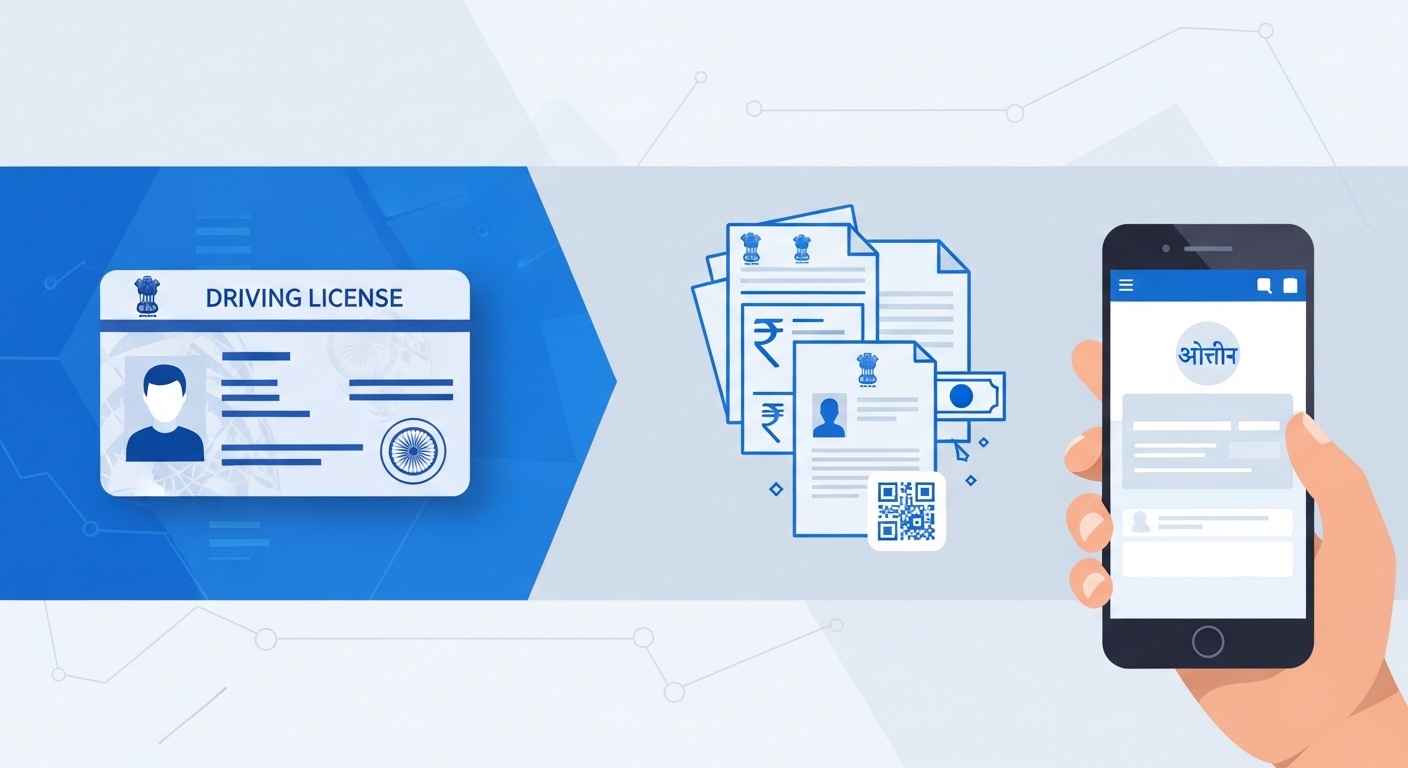
Digital applications for driving licence services in India are projected to cross 150 million by the end of 2026, showcasing a significant shift towards online governmental processes. This surge highlights the increasing reliance on digital platforms for essential services, making it crucial for citizens to understand how to manage their personal details accurately.
However, even with advanced digital systems, errors in personal information like your name or address on a driving licence can occur, leading to significant inconvenience. Correcting these vital details promptly ensures your legal identity remains consistent across all official records and prevents future complications.
Table of Contents
Why Correct Your Driving Licence Details?
Your driving licence (DL) isn’t just a permit to drive; it’s a crucial identity document widely accepted across India. Maintaining accurate information on it is not merely a suggestion; it’s a legal requirement that protects you in various situations. Discrepancies can lead to significant hurdles, from minor inconveniences to serious legal challenges.
Having incorrect details on your driving licence can cause issues during traffic stops, identity verification processes, and even when applying for other official documents or services. It’s essential to ensure that your DL accurately reflects your current legal name and residential address. This proactive approach helps you avoid unnecessary complications down the line.
Legal Requirement
It’s a legal mandate to have accurate personal details on all government-issued identity documents, including your driving licence. Driving with a licence that contains outdated or incorrect information, especially your address, could be considered a violation in certain circumstances. This is because your licence serves as verifiable proof of your identity and residence, which must be current.
Important for Identity
Your driving licence often acts as a primary form of identification, particularly for age and address verification. When your name or address changes, perhaps due to marriage, relocation, or other legal reasons, your DL must reflect these updates. This consistency ensures your identity is uniformly recognised across all official and private sector interactions.
Quick Context: Why is DL Accuracy Important?
Your driving licence is a primary legal document. Inaccurate details can lead to fines, legal complications, and issues with identity verification for banking, travel, and other essential services.
Avoid Future Problems
Delaying corrections can snowball into larger issues. Imagine needing to open a bank account or apply for a passport, only to find that your driving licence details don’t match other proofs. This discrepancy can cause significant delays or even outright rejection of your applications, costing you time and effort.
Potential Problems with Incorrect DL Details
- Penalties for misrepresentation during traffic checks.
- Difficulty in proving identity for financial transactions or government services.
- Delays in processing other official documents like passports or Aadhaar updates.
- Challenges in insurance claims if your address on the DL doesn’t match policy records.
Understanding General Requirements
Before you begin the correction process, it’s helpful to understand the foundational requirements applicable to all changes. Whether you’re updating your address, name, or both, certain documents and procedures are universally necessary. Familiarising yourself with these ensures a smoother application experience, saving you time and preventing repeated visits to the RTO.
The Regional Transport Office (RTO) typically requires a set of standard documents to process any changes to your driving licence. These are designed to verify your identity and the authenticity of your request. Always remember to carry both original documents for verification and self-attested copies for submission.
Original Licence Needed
You must submit your original driving licence during the application process. This is a critical step, as the RTO needs to either endorse the changes on your existing licence or issue a completely new one with the updated details. Submitting the original also prevents any fraudulent attempts to alter your licence.
Proof of Identity
To confirm that you are indeed the licence holder requesting the change, you’ll need to provide valid proof of identity. Documents like your Aadhaar card, PAN card, or passport are commonly accepted. The RTO uses these to cross-reference your personal details and ensure consistency across government records, protecting against identity theft.
Common Confusion: DL Expiry and Corrections
It is commonly assumed that you cannot correct your DL details if it’s expired
You can apply for corrections even if your DL has expired, but you’ll also need to apply for renewal simultaneously. The RTO will process both requests together.
Proof of Address
For any address correction, up-to-date proof of your new residence is mandatory. This document helps the RTO verify your current living location and update their records accordingly. Utility bills, bank statements, or a registered rental agreement are standard proofs accepted for this purpose.
Application Form Details
You’ll need to fill out specific application forms, such as Form 2 (Application for Grant/Renewal of Learner’s Licence/Driving Licence) and Form LLD (Application for Change of Address/Name in Driving Licence). Accuracy is paramount when completing these forms; any errors could lead to your application being rejected. Carefully review all entries before submission.
General Documents Required for DL Corrections
- Your original Driving Licence.
- Valid proof of identity (e.g., Aadhaar card, Passport, PAN card).
- Proof of current address (e.g., Utility bill, Bank statement, Rental agreement).
- Duly filled application forms (Form 2 and Form LLD, as applicable).
- Recent passport-sized photographs (usually 2-3 copies).
What Documents Do You Need for Address Correction?
Changing your address on your driving licence is a common procedure, especially given the mobility of people across cities and states. The RTO requires specific documents to validate your new residential address. Providing the correct proofs ensures that your updated licence accurately reflects where you live, which is vital for official communications and verification.
It’s important to choose documents that are recent and clearly show your name and the new address. The RTO scrutinises these proofs to prevent any misrepresentation or fraudulent address changes. Always ensure your chosen document is not older than a few months to demonstrate current residency.
Proof of New Address
The most crucial document for an address change is a valid proof of your new residence. This can be any official document that clearly states your name and the new address you wish to register. Without this, your application for an address correction cannot proceed, as the RTO needs verifiable evidence.
Utility Bills Accepted
Utility bills are widely accepted as proof of address, provided they are recent. You can submit electricity bills, water bills, or gas connection bills, typically not older than three months from the application date. Ensure the bill is in your name or the name of a close family member residing at the same address.
Pro Tip: Check Document Validity
Before submitting, always check the issuance date of your address proof. Most RTOs require utility bills or bank statements to be less than three months old to ensure they reflect your current residency.
Bank Statements Valid
A recent bank passbook or statement from any scheduled bank, showing your new address, is also considered valid proof. Similar to utility bills, these should ideally be no older than three months. It confirms your financial association with the new address, adding another layer of verification.
Rental Agreement Proof
If you live in rented accommodation, a registered rental agreement can serve as proof of address. Ensure the agreement is legally registered and clearly states your name, the landlord’s name, and the full address. An unregistered agreement might not be accepted by all RTOs, so verify this requirement beforehand.
Aadhaar Card Details
Your Aadhaar card is a highly versatile document and can often be used as proof of address, provided the address on it is already updated to your new residence. If your Aadhaar card also needs an address update, it’s advisable to complete that process first before applying for the DL correction.
Acceptable Documents for Address Correction
- Aadhaar Card (with updated address).
- Passport (with updated address).
- Latest Utility Bills (electricity, water, gas) not older than 3 months.
- Bank Passbook or Statement (not older than 3 months).
- Registered Rent/Lease Agreement.
- Voter ID Card (with updated address).
Documents for Correcting Your Name
Correcting your name on a driving licence is a more involved process than an address change, as it deals with your fundamental identity. This is typically required after marriage, divorce, or a legal name change through a gazette notification. The RTO demands robust evidence to ensure the legitimacy of such a significant alteration.
The primary goal of the RTO is to prevent identity fraud and ensure that any name change is legally sanctioned. Therefore, the documents required are usually legal certificates that formally establish your new name. Always prepare certified copies alongside the originals for verification.
Proof of Name Change
The most critical document is official proof of your name change. This could be a marriage certificate, a divorce decree, or a gazette notification, depending on the reason for the change. Without this foundational evidence, the RTO cannot legally process your name correction request.
Marriage Certificate Needed
For women who change their surname after marriage, a marriage certificate is the primary document required. This certificate legally validates the change in your marital status and, consequently, your surname. Ensure it is issued by the competent authority and is properly registered.
Common Confusion: Name Change Affidavit
A widespread myth is that a simple affidavit is enough for a name change on a DL
While an affidavit is often a supporting document, it must be accompanied by a Gazette notification for a full legal name change, or a marriage certificate for a change post-marriage.
Gazette Notification Copy
If your name change is not due to marriage (e.g., a complete change of first name or surname for other reasons), a copy of the Gazette of India notification is essential. This official publication publicly declares your name change and serves as undeniable legal proof. You must publish an advertisement in a local newspaper as well.
Affidavit Requirements
An affidavit, sworn before a Notary Public or a Magistrate, is often required to support your application for a name change. This document formally declares your old name, new name, and the reason for the change. While crucial, it usually acts as a supplementary document to the primary proof like a marriage certificate or Gazette notification.
Passport as Evidence
If your new name is already updated on your passport, it can serve as strong evidence. A passport is a globally recognised identity document, and if it reflects your new name, the RTO will typically accept it as valid proof. This is especially useful if you’ve already completed the name change process for your passport.
Essential Documents for Name Correction
- Original Driving Licence.
- Marriage Certificate (for name change after marriage).
- Copy of Gazette of India notification (for other legal name changes).
- Affidavit sworn before a Notary Public/Magistrate.
- Proof of identity (e.g., Aadhaar, PAN card, Passport with new name).
- Newspaper advertisements (if required for Gazette notification).
Applying for Both Address and Name Changes
Sometimes, you might need to update both your address and name on your driving licence simultaneously. This often happens when moving after marriage, for instance.
Fortunately, the RTO typically allows for a combined application process, streamlining the procedure for your convenience. However, it requires meticulous attention to detail and a comprehensive set of documents.
When submitting a combined application, you must ensure that all necessary documents for both types of corrections are included. Missing even a single required proof can lead to delays or rejection of your entire application. It’s best to prepare a checklist beforehand to confirm everything is in order.
Combined Application Process
Most RTOs facilitate a combined application for both address and name changes. This means you won’t necessarily have to go through two separate processes.
You’ll typically fill out a single application form (Form LLD) indicating both types of corrections, alongside Form 2. This integrated approach saves you time and effort.
Submit All Documents
For a combined application, you must present all the documents required for each type of correction. This includes proofs for your new address (like utility bills or Aadhaar) and proofs for your name change (like a marriage certificate or Gazette notification). Organise your documents clearly to assist the RTO staff during verification.
Quick Context: Combined Application Benefits
Applying for both address and name changes together simplifies the process, requiring only one visit to the RTO and a single set of application forms. This efficiency saves time compared to separate applications.
Follow Specific Order
While there isn’t a strict universal order for submitting documents, it’s good practice to arrange them logically. Start with the application forms, followed by your original DL, then your identity proof, and finally, the specific proofs for address and name changes. This systematic approach can help expedite the verification process at the RTO counter.
Step 1: Gather all necessary documents for both name and address changes, including your original driving licence, identity proof, and specific proofs like marriage certificate or utility bills.
Step 2: Fill out Form LLD, clearly marking the sections for both name and address corrections, and complete Form 2 as required for a new card issuance.
Step 3: Attach self-attested copies of all supporting documents to the application forms, ensuring that each copy is legible and accurate.
Step 4: Visit your designated RTO with all original documents for verification, the completed forms, and the attached copies.
How to Apply for Your Corrections
Once you have all your documents in order, the next step is to physically apply for the corrections at your local Regional Transport Office (RTO). While some states are moving towards more online services for certain DL-related tasks, corrections involving significant changes like name or address often require an in-person visit. This ensures proper verification and biometric capture if needed.
The application process at the RTO involves several key stages, from form submission to fee payment. Being prepared for each step will help you complete the process efficiently. Remember that RTOs can be busy, so arriving early with all documents ready is always a good strategy.
Visit Your RTO
You must visit the RTO that issued your original driving licence or the RTO that has jurisdiction over your new address. Check your state transport department’s website for specific RTO locations and operating hours. Some RTOs might require you to book an appointment online before your visit, especially in larger cities.
Fill Out the Forms
At the RTO, or often downloadable online, you’ll need to obtain and fill out the relevant application forms. These typically include Form 2 and Form LLD.
Carefully complete all sections, ensuring that the new name and address details are accurately entered, matching your supporting documents. Avoid any overwriting or corrections without proper attestation.
Common Confusion: Online DL Corrections
The misunderstanding here is that all DL corrections can be done entirely online in every state
While many states offer online application submission and appointment booking, corrections for name and address often require an in-person visit to the RTO for document verification and submission.
Submit Required Documents
Present your completed application forms along with all the original documents and their self-attested copies to the designated counter at the RTO. The RTO official will verify your original documents against the copies and the information provided in your forms. This step is crucial for the legitimacy of your application.
Pay the Fees
After successful verification of your documents, you will be directed to pay the prescribed fees. As of 2026, the fees for DL corrections typically range from Rs 200 to Rs 500, though this can vary slightly by state and the specific type of correction. Keep the payment receipt safe, as it serves as proof of your application.
Step 1: Identify the correct RTO jurisdiction for your application and check if an online appointment is required for an in-person visit.
Step 2: Download and fill out Form 2 and Form LLD completely and accurately, ensuring all new details match your supporting documents.
Step 3: Visit the RTO with your original driving licence, all supporting original documents, and self-attested copies, along with your filled forms.
Step 4: Submit your application and documents at the designated counter, undergoing initial verification by the RTO official.
Step 5: Pay the required processing fees at the cashier’s counter and collect your payment receipt, which confirms your application submission.
What Happens After You Apply?
Submitting your application is just the first part of the journey. Once your documents and forms are submitted and fees paid, the RTO initiates its internal process to verify your request.
Understanding what happens next can help manage your expectations regarding timelines and how your updated driving licence will be issued. The entire process is designed to ensure accuracy and prevent fraud.
The RTO’s verification steps are thorough, involving cross-referencing your details with various databases. This is why patience is key after submission. You won’t receive your updated licence immediately, but there are ways to track its status and understand when to expect it.
Verification Process Begins
After submission, the RTO begins the verification of your provided documents and information. This can involve checking the authenticity of your proofs, especially for name changes, and cross-referencing your details with the central driving licence database. This process ensures the integrity of the updated information.
Receiving Your Updated DL
Once the verification process is complete and approved, your updated driving licence will be dispatched. This typically happens via speed post to your new registered address. The timeframe for receiving the new DL can vary from a few weeks to a couple of months, depending on the RTO’s workload and state-specific processing times.
Pro Tip: Track Your Application Status
Many state transport department websites offer an online portal where you can track the status of your driving licence application using your application number. Regularly checking this can provide updates on processing and dispatch.
Temporary Licence Options
While you wait for your new physical driving licence, the RTO may issue a temporary acknowledgement receipt. This receipt, along with your old driving licence, can sometimes serve as interim proof that you have applied for corrections. However, its acceptance can vary, so always confirm its validity for driving purposes.
| Stage | Description | Estimated Timeframe |
| Application Submission | Handing over forms and documents at RTO | Same day |
| Document Verification | RTO checks authenticity of proofs | 1-2 weeks |
| Approval & Printing | Internal processing and DL card preparation | 2-4 weeks |
| Dispatch & Delivery | New DL sent to your registered address | 1-3 weeks |
When Should You NOT Correct Your DL Details?
While correcting your driving licence details is crucial for accuracy, there are specific situations where initiating a correction might not be the best course of action. Understanding these exceptions can save you unnecessary effort, fees, and potential complications. It’s about making an informed decision rather than rushing into a process that might not be suitable at a given time.
Not every perceived discrepancy warrants an immediate RTO application. Sometimes, a minor typographical error might not impact the legal validity of your document, or you might be in a transitional phase that makes a correction premature. Consider these points before proceeding.
Situations When DL Correction Might Not Be Advisable
- Minor Typographical Errors: If the error is a very minor typo (e.g., an extra space, a missing comma) that doesn’t alter the meaning or your identity, and it’s not causing any issues with other official documents, a correction might not be immediately necessary. However, if it causes problems, you should correct it.
- Pending Other Major Document Updates: If you are in the process of updating your name or address on more fundamental documents like your Aadhaar or passport, it’s often better to wait until those are finalised. This ensures consistency and avoids multiple correction cycles.
- Imminent Relocation: If you know you will be moving again within a short period (e.g., within the next 3-6 months), it might be more practical to wait until you settle into your new, more permanent address before applying for an address change on your DL. This prevents having to apply for another correction soon after.
- Temporary Name Changes: If you are using a temporary name for a specific, non-legal purpose, and do not intend to legally change your name, you should not apply for a DL correction. The RTO only processes legal and permanent name changes.
Conclusion
Promptly initiating corrections for your driving licence details, whether it’s your name or address, is a vital administrative task that ensures your legal identity remains consistent and valid. By carefully gathering the required documents and following the step-by-step application process outlined, you can navigate the RTO procedures efficiently. This proactive approach helps you avoid potential legal issues and ensures smooth identity verification across all official platforms.
Author

