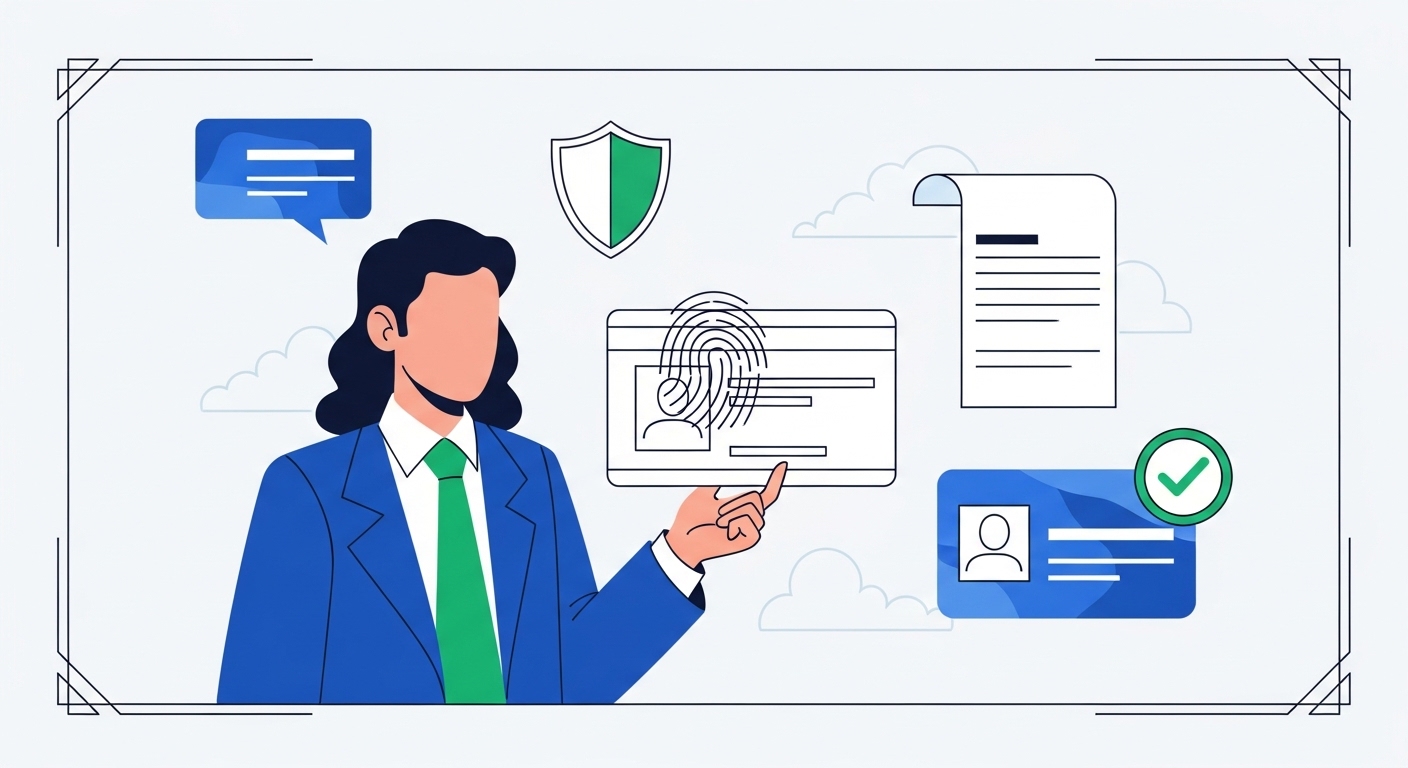
Verifying your identity for digital currency is much like showing your ID to enter a secure building or boarding a flight. It’s a necessary check that confirms who you are, ensuring everyone’s safety within the system. Without it, the digital doors stay closed, limiting your access to important services.
This guide will help you understand why this verification, known as KYC, is mandatory for your digital wallets in 2026. You’ll learn the exact rules, what documents you need, and how to complete the process smoothly. Completing KYC protects your money and unlocks all features, making your digital finance journey safer and more convenient.
Table of Contents
What Is KYC?
Know Your Customer, or KYC, is a mandatory verification process governed by the Reserve Bank of India (RBI) for financial institutions, including digital wallet providers. It involves collecting and verifying a customer’s identity and address details to prevent financial fraud, money laundering, and terrorist financing.
This process typically uses official documents like Aadhaar and PAN to establish your unique financial identity. As of 2026, digital wallets often have a basic usage limit of as per the latest official guidelines per month for non-KYC compliant accounts, as per official RBI guidelines.
If you don’t complete full KYC, your wallet services will be severely restricted, impacting transactions and withdrawals, potentially leading to account suspension or closure. You can usually initiate your KYC process directly through your digital wallet application, often requiring Aadhaar and PAN details, or by visiting a designated agent.
What Is KYC for Digital Currency?
KYC stands for “Know Your Customer,” and it’s a set of rules and procedures that financial institutions use to verify the identity of their clients. This process ensures that you are who you say you are, helping to create a secure environment for everyone using digital payment systems. It’s a crucial step in maintaining the integrity of India’s rapidly growing digital economy.
What KYC truly means goes beyond just checking your name and address. It’s about understanding your financial behaviour and ensuring that digital wallets aren’t used for illicit activities. This proactive approach helps prevent misuse of digital platforms, which is vital for the safety of your funds and the wider financial system.
Quick Context: What’s the “K” in KYC?
The “K” in KYC stands for “Know,” meaning financial institutions must actively understand their customers’ identities, financial activities, and risks. This isn’t just about collecting documents; it’s about continuous monitoring.
Why verification is vital
Verification is vital because it acts as a strong defence against financial crimes like money laundering and fraud. By confirming your identity, digital wallet providers can track transactions more effectively and report suspicious activities to the authorities. This protects you from becoming an unwitting participant in illegal schemes.
Protecting your digital money
Protecting your digital money is a primary goal of KYC. When your identity is verified, it becomes much harder for someone else to open an account in your name or misuse your existing wallet. This layer of security adds confidence to your digital transactions, ensuring your funds remain safe.
Key Aspects of KYC:
- Identity Confirmation: Verifying your name, date of birth, and other personal details using official documents.
- Address Validation: Confirming your residential address to ensure communication and regulatory compliance.
- Risk Assessment: Evaluating the potential risk associated with your account to prevent fraud and financial crime.
- Ongoing Monitoring: Regularly checking transactions for unusual patterns that might indicate suspicious activity.
Why Is KYC Important for Your Digital Wallet?
KYC is important for your digital wallet because it underpins the entire trust framework of digital payments in India. Without these checks, digital wallets would be vulnerable to misuse, which could erode public confidence in online transactions. This process helps secure the vast network of digital payments, including those powered by UPI, which saw significant transaction volumes in 2026, according to NPCI (2026).
It’s not just about stopping criminals; it’s also about ensuring the stability and reliability of the financial system. When every user is verified, the ecosystem becomes more transparent and accountable. This transparency is crucial for the continued growth of India’s digital economy, a key objective of the Digital India Programme (2026).
Common Confusion: The misunderstanding here is that KYC is only a burden for users.
In reality, KYC is a vital protective measure that benefits both users and the financial system by preventing fraud and ensuring regulatory compliance.
It safeguards your funds and promotes a secure digital environment.
Stopping illegal activities
Stopping illegal activities is the primary driver behind KYC regulations. By collecting and verifying customer data, financial institutions can detect and report suspicious transactions that might be linked to money laundering, terrorism financing, or other criminal acts. This makes it much harder for criminals to use digital wallets for their illicit purposes.
Following government guidelines
Following government guidelines is non-negotiable for all financial service providers. The Reserve Bank of India (RBI) mandates KYC compliance to maintain a robust and secure financial system. These guidelines are regularly updated to address new threats and technological advancements, ensuring that your digital transactions remain protected.
Building trust and safety
Building trust and safety is a direct outcome of effective KYC implementation. When you know that other users on the platform have also been verified, it creates a sense of security and reliability. This trust encourages more people to adopt digital payments, contributing to a truly cashless economy.
| Aspect | Without KYC | With KYC |
| Transaction Limits | Severely restricted, e.g., as per the latest official guidelines monthly | Full access to higher limits as per official guidelines |
| Wallet Features | Basic transactions only, no bank transfers | All features, including bank transfers and bill payments |
| Security & Fraud | Higher risk of misuse and account compromise | Enhanced protection against fraud and identity theft |
| Regulatory Compliance | Non-compliant, potential account suspension | Fully compliant, secure and uninterrupted service |
How Do You Complete Your KYC Verification?
Completing your KYC verification is a straightforward process designed to be as convenient as possible in 2026. Most digital wallet providers offer multiple ways to get this done, from fully online methods to visiting a physical agent. The goal is to ensure that everyone can comply with the regulations without unnecessary hassle.
It’s important to remember that the exact steps might vary slightly depending on your specific digital wallet provider. However, the core requirements and the types of documents needed remain consistent across the board. Always make sure you’re using the official app or website for verification to avoid scams.
Pro Tip: Speed Up Your KYC
Have your Aadhaar number and PAN card details ready before you start your online KYC process. This will significantly speed up the verification, often allowing instant e-KYC completion.
Simple steps to follow
The simplest way to complete your KYC is often through the digital wallet app itself. You’ll typically be guided through a series of screens where you upload document images or provide details. Make sure your documents are clear and readable to avoid rejection.
Online verification options
Online verification options have become the most popular choice due to their convenience. Many platforms use Aadhaar-based e-KYC, where you provide your Aadhaar number and consent for an OTP-based verification. This links your digital identity from the India Stack (2026) directly to your wallet.
You might also use video-based KYC (V-KYC), where a live agent verifies your documents and identity over a video call. This method is gaining popularity for its balance of security and convenience, allowing for real-time verification from your home. Always ensure you have good lighting and a stable internet connection for V-KYC.
In-person verification process
For those who prefer or require it, an in-person verification process is also available. This involves visiting a designated agent or a branch of the wallet provider with your original documents. The agent will verify your details and submit them for processing, often providing immediate confirmation.
Step 1: Open your digital wallet app and look for the “Complete KYC” or “Verify Account” section. You’ll usually find this under your profile or settings.
Step 2: Choose your preferred verification method, such as Aadhaar e-KYC, video KYC, or document upload. Follow the on-screen instructions carefully.
Step 3: Provide the necessary documents, such as your Aadhaar card and PAN card. For e-KYC, you’ll enter your Aadhaar number and an OTP sent to your registered mobile number.
Step 4: If uploading documents, ensure photos are clear, well-lit, and show all four corners of the document. Submit your details for review.
Step 5: Wait for confirmation from your wallet provider, which typically arrives via SMS or email within a few hours or days. After successful verification, your wallet limits will be updated.
What Documents Will You Need for KYC?
To complete your KYC verification, you’ll primarily need documents that prove your identity and your current address. These are standard requirements set by the Reserve Bank of India to ensure robust identification. Having these documents ready makes the entire process much faster and smoother.
It’s crucial that the names and addresses on your identity and address proofs match exactly. Any discrepancies can lead to delays or even rejection of your KYC application. Always use original documents or clear, legible copies when submitting.
Common Confusion: It is commonly assumed that any photo ID will work for KYC.
While many IDs are accepted, you specifically need government-issued documents that include both your photograph and full name, such as an Aadhaar card or PAN card, to meet official RBI guidelines.
Proof of your identity
Proof of your identity is essential to establish who you are. The most commonly accepted documents in India include your Permanent Account Number (PAN) card and your Aadhaar card. These documents contain unique identifiers that are linked to your personal data.
Other accepted identity proofs might include your passport, driving licence, or Voter ID card. Ensure the document is current and hasn’t expired, especially for passports or driving licences. Your photo on the document should also be clearly visible.
Proof of your address
Proof of your address confirms where you live. Your Aadhaar card often serves as both identity and address proof, which simplifies the process. Other valid documents include your passport, driving licence, or utility bills (electricity, water, gas) that are not more than two months old.
Bank account statements or property tax receipts can also be accepted as address proof. Always check with your specific digital wallet provider for their exact list of accepted documents, as it can sometimes vary slightly.
Additional information needed
Beyond identity and address, you might need to provide additional information during your KYC process. This often includes your occupation, annual income, and sometimes a nominee’s details. This data helps the financial institution understand your risk profile better.
You may also be asked to provide a recent photograph, especially if you’re undertaking an in-person or video KYC. Always ensure the photo is clear, recent, and meets any specified format requirements.
Common Documents for KYC:
- Aadhaar Card: Accepted as both identity and address proof, enabling e-KYC.
- PAN Card: Mandatory for financial transactions above certain limits and for tax purposes.
- Passport: Valid for both identity and address verification.
- Driving Licence: Accepted for identity and address, provided it’s current.
- Voter ID Card: Primarily used as identity proof.
- Utility Bills: (Electricity, Water, Gas) – Not older than two months, for address proof.
Benefits of Completing Your KYC
Completing your KYC offers a range of significant benefits that enhance your digital finance experience. It’s not just a regulatory hurdle; it’s a gateway to full functionality, greater security, and peace of mind. You’ll quickly realise the advantages once your account is fully verified.
Think about it: an unverified wallet is like a car with a speed limiter; it works, but you can’t access its full potential. KYC removes these limitations, allowing you to use your digital wallet to its fullest capacity. This helps you manage your money more effectively and securely.
Pro Tip: Unlock Higher Limits
After completing full KYC, your digital wallet transaction limits will typically increase significantly, often allowing transactions up to as per the latest official guidelines or more per month, as per official guidelines, depending on the provider and RBI norms.
Securing your digital funds
Securing your digital funds is perhaps the most critical benefit of KYC. With your identity verified, it becomes much harder for fraudsters to access or misuse your wallet. This robust authentication process provides a strong shield against financial crimes.
In cases of suspicious activity, a verified account allows for quicker resolution and recovery of funds, as your identity is already established. This makes your digital transactions much safer.
Unlocking full wallet features
Unlocking full wallet features is another major advantage. Without KYC, you’re typically restricted to basic transactions like small payments to merchants. Full KYC enables you to send money to bank accounts, withdraw funds, and handle larger transaction amounts.
You can also access services like bill payments, recharges, and sometimes even digital lending options, all from your verified wallet. This transforms your digital wallet into a powerful financial tool.
Smooth and safe transactions
Smooth and safe transactions become the norm once your KYC is complete. You won’t face interruptions due to transaction limits or verification requests. This ensures a seamless experience every time you use your digital wallet.
Furthermore, the enhanced security means you can transact with greater confidence, knowing that your financial activities are protected by regulatory standards. This contributes significantly to your overall digital payment experience.
Key Benefits of Full KYC:
- Increased Transaction Limits: Enjoy higher spending and transfer limits, often up to as per the latest official guidelines per month or more.
- Bank Account Transfers: Easily send money from your wallet directly to any bank account.
- Cash Withdrawal Options: Access facilities to withdraw cash from your digital wallet if offered by your provider.
- Enhanced Security: Stronger protection against fraud, identity theft, and unauthorised access.
- Full Service Access: Unlock all features, including bill payments, recharges, and other financial services.
- Regulatory Compliance: Ensure your account is fully compliant with RBI regulations, avoiding future restrictions.
Understanding the Consequences of Not Completing KYC
Not completing your KYC verification carries significant consequences that can severely limit your digital wallet’s usefulness. These restrictions aren’t arbitrary; they are in place to prevent misuse and ensure compliance with anti-money laundering regulations. Ignoring KYC can turn your convenient digital wallet into a source of frustration.
You might find yourself unable to perform even basic transactions, especially as regulatory bodies like the RBI continue to tighten financial security protocols in 2026. It’s far better to complete the process proactively than to face disruptions when you need your wallet most.
Common Confusion: A widespread myth is that you can simply use another wallet if one gets restricted for KYC.
While you might open another wallet, all regulated digital payment providers are subject to the same KYC rules, meaning you’ll eventually face the same restrictions across all platforms if you don’t complete verification.
Limited access to services
Limited access to services is the most immediate consequence of incomplete KYC. Your wallet will likely operate under “minimum KYC” rules, meaning you can only perform small-value transactions, typically up to as per the latest official guidelines per month. This prevents you from making larger payments or transfers.
You won’t be able to send money to bank accounts or withdraw cash, severely hindering your financial flexibility. Essential features that make digital wallets convenient will simply be unavailable to you.
Account restrictions applied
Account restrictions applied due to non-KYC compliance can include limitations on the total amount you can store in your wallet. Over time, your wallet might even be blocked from receiving funds. This means friends or family won’t be able to send money to you digitally.
These restrictions are designed to push users towards full compliance, ensuring that all participants in the digital economy are properly identified. It safeguards the system from potential financial crime.
Risk of account closure
The risk of account closure is a serious consequence if KYC remains incomplete for an extended period. Digital wallet providers are mandated to close non-KYC compliant accounts after a certain timeframe, as per official RBI guidelines. This means you could lose access to any funds remaining in the wallet.
Before closure, providers typically issue multiple reminders and warnings, giving you ample opportunity to complete the verification. Always act promptly to avoid losing access to your digital funds.
Consequences of Incomplete KYC:
- Low Transaction Limits: Restricted to small-value transactions, often as per the latest official guidelines per month.
- No Bank Transfers: Inability to send money from your wallet to a bank account.
- No Cash Withdrawals: Cannot withdraw physical cash from your digital wallet.
- Wallet Balance Limits: Restrictions on the maximum amount you can hold in your wallet.
- Account Suspension/Closure: Potential for your account to be temporarily suspended or permanently closed.
- Limited Features: Access only to basic payment functionalities, missing out on advanced services.
Looking Ahead: The Future of Digital Identity and KYC
The future of digital identity and KYC in India is continuously evolving, driven by technological advancements and the push for greater digital inclusion. Initiatives like the India Stack are paving the way for more streamlined and secure verification processes. You can expect KYC to become even more efficient and user-friendly.
This evolution aims to strike a balance between robust security and ease of access for millions of Indians, including those in rural areas being brought into the digital fold by programmes like PMGDISHA (2026). Staying informed about these changes will help you navigate the digital finance landscape confidently.
Pro Tip: Keep Your Aadhaar Updated
Regularly update your Aadhaar details, especially your mobile number and address, at an Aadhaar Enrolment Centre. This ensures smooth e-KYC processes for all your financial services.
Evolving verification methods
Evolving verification methods will likely include more advanced forms of biometric authentication and AI-driven identity checks. These technologies promise to make KYC not only faster but also more secure, reducing the potential for fraud. Digital signatures, facilitated by eSign (2026), are also becoming more commonplace for secure online agreements.
You might see greater integration of digital locker services, allowing you to securely share verified documents with financial institutions. This reduces the need for repeated document submissions, streamlining your experience across different platforms.
Staying updated with regulations
Staying updated with regulations is crucial as the digital finance sector matures. The RBI and other regulatory bodies, such as SEBI (2026) for capital markets, regularly issue new guidelines to adapt to emerging technologies and risks. These updates directly impact how KYC is performed and what is required of you.
Make it a habit to check official government portals and your digital wallet provider’s announcements for any changes. This proactive approach ensures you always remain compliant and avoid unexpected service interruptions.
Your journey in digital finance
Your journey in digital finance is becoming increasingly interconnected with your digital identity. A fully verified KYC profile acts as your passport to a secure and comprehensive range of financial services. It empowers you to participate fully in India’s digital economy.
Embracing KYC is not just about following rules; it’s about safeguarding your financial future in an increasingly digital world. It’s a foundational step towards building a trusted and efficient payment ecosystem for everyone.
Step 1: Regularly check your digital wallet app or email for notifications about new KYC requirements or updates. Providers will inform you of any changes.
Step 2: Review official sources like the RBI website or the Ministry of Electronics & IT (2026) for broader regulatory changes impacting digital payments.
Step 3: Ensure your identity documents, especially Aadhaar and PAN, are always current and their details match across all your financial accounts.
Step 4: Take advantage of new, more convenient KYC methods as they become available, such as enhanced e-KYC or V-KYC, to keep your verification up-to-date.
Sources
Conclusion
Completing your KYC for digital currency is a fundamental step towards a secure and fully functional digital wallet experience. By taking the time to verify your identity, you actively protect your funds from fraud and unlock all the powerful features your wallet offers. Make sure to complete your KYC promptly to enjoy increased transaction limits and seamless digital payments in 2026.
How to complete KYC for my digital wallet online?
What documents are required for digital wallet KYC in India?
Can I use my digital wallet without completing full KYC?
Why is KYC mandatory for digital wallets, and how does it protect my money?
What are the key benefits of completing full KYC for my digital wallet compared to having a basic, unverified account?
Is video KYC (V-KYC) a secure and reliable method for verifying my digital wallet in India?
What happens if my KYC application is rejected, or if there's a discrepancy in my documents?
Which KYC verification method is fastest or most convenient for digital wallets: online e-KYC, video KYC, or in-person?
Author
