

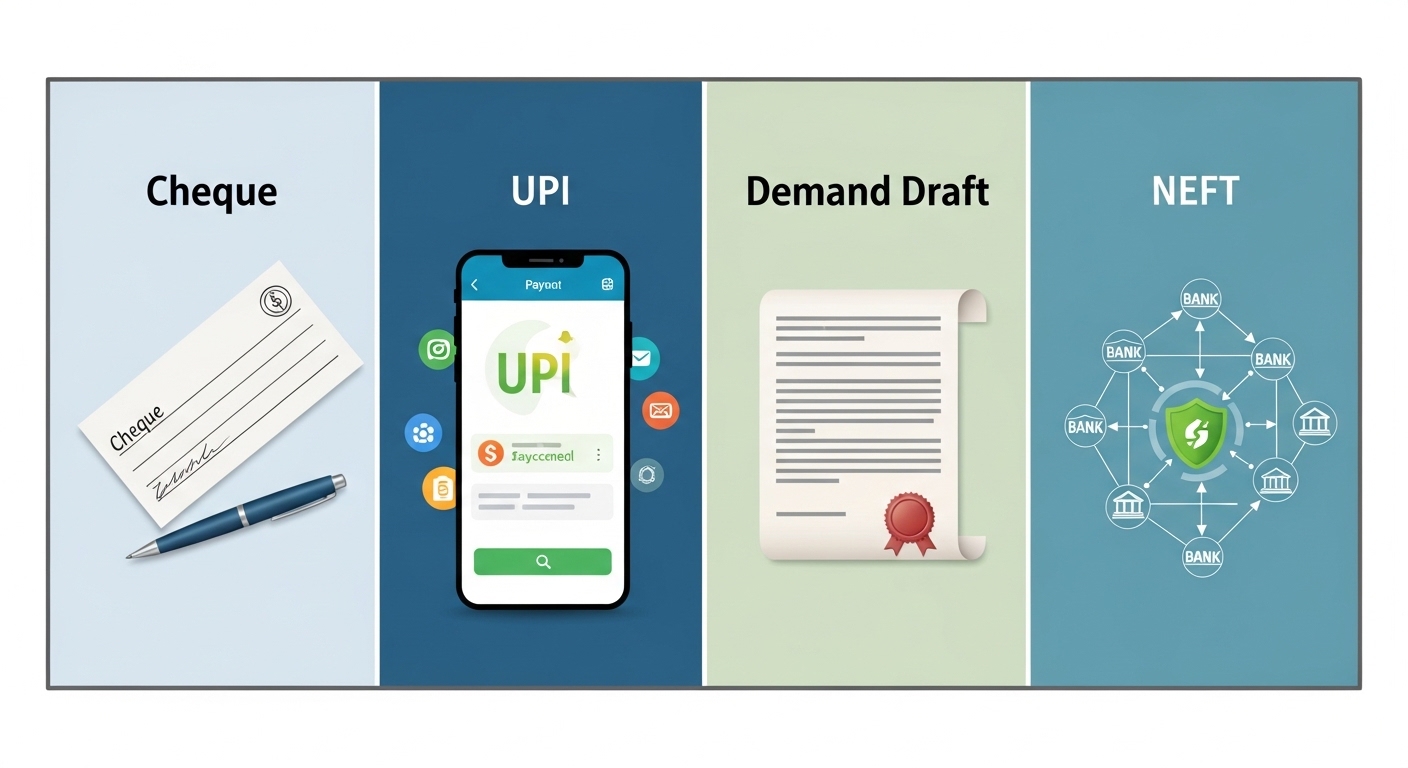
Many people believe that all modern payment methods are equally fast and reliable. Actually, each option, from traditional cheques to instant UPI, serves distinct purposes with varying speeds and security features. Understanding these differences is crucial for managing your money effectively in 2026.
It’s a common misconception that cheques are no longer relevant in today’s digital economy. However, cheques and demand drafts still offer unique advantages for specific situations, while NEFT and UPI excel in others. Knowing when to use each method can save you time and prevent financial headaches.
Understanding the various payment methods available in India, such as cheques, UPI, Demand Drafts, and NEFT, is essential for every individual and business. These methods are governed primarily by the Reserve Bank of India (RBI) and the National Payments Corporation of India (NPCI), ensuring a structured and secure financial ecosystem for all transactions.
A cheque involves a physical paper instruction, clearing through the Cheque Truncation System (CTS) as per RBI guidelines. UPI, on the other hand, facilitates instant mobile payments, often with a daily limit of ₹1 lakh per bank account for most transactions, as per the latest NPCI guidelines (2026). Dem
and Drafts offer bank-guaranteed payments, eliminating the risk of bouncing, while NEFT processes electronic transfers in batches throughout the day. Choosing an unsuitable method can lead to significant delays, missed payments, or even unnecessary fees. The
refore, you should familiarise yourself with each option to make informed financial decisions and ensure smooth financial operations.
Table of Contents
What Is a Cheque?
A cheque is a physical piece of paper that tells your bank to pay a specific amount of money from your account to another person or organisation. It’s a traditional payment method that has been used for a long time, acting as a written instruction. You need to have sufficient funds in your bank account for the cheque to be honoured.
This method requires both the payer and the payee to have bank accounts. Once written and signed, the cheque can be deposited by the recipient into their own bank account. The bank then initiates a process to transfer the funds.
Paper payment instruction
A cheque serves as a formal, written instruction to your bank. It directs them to release a specific sum of money from your account. This instruction is legally binding, provided all details are correct and your account has enough balance.
Bank account needed
To issue a cheque, you must hold an active bank account with a chequebook facility. Similarly, the person or entity receiving the cheque also needs a bank account to deposit it. This ensures traceability and proper record-keeping for both parties.
Dated and signed
Every cheque must be dated and signed by the account holder. The date specifies when the cheque can be presented for payment, and your signature authorises the transaction. Without these essential elements, the cheque is invalid and cannot be processed by the bank.
How Does a Cheque Work for You?
When you write a cheque, you’re essentially giving a promise to pay. The process involves several steps, from writing the cheque to its final clearing. Understanding this helps you appreciate its role in financial transactions.
The recipient then takes the cheque to their bank for deposit. This triggers the bank’s internal process to claim the funds from your bank. The entire journey ensures that money moves securely between accounts.
Writing the cheque
Step 1: Fill in the payee’s name accurately, ensuring there are no spelling mistakes. This prevents the cheque from being paid to the wrong person.
Step 2: Write the amount in both numbers and words, making sure they match exactly. If there’s a discrepancy, the amount in words is usually considered valid.
Step 3: Add the current date and sign the cheque exactly as your signature appears in your bank records. A mismatch could lead to the cheque being dishonoured.
Step 4: Keep a record of the cheque number, date, payee, and amount for your own accounting. This helps you track your expenses and manage your balance.
Common Confusion: Cheque Validity
It is commonly assumed that a cheque is valid indefinitely until cashed
A cheque is typically valid for three months from its date of issue, after which it becomes stale and will not be honoured by the bank.
Depositing funds
Once the recipient deposits the cheque into their bank account, their bank sends it for clearing. This is done through the Cheque Truncation System (CTS), which digitises the cheque image. The physical cheque doesn’t travel between banks anymore, making the process faster.
Clearing process
The Cheque Truncation System (CTS), managed by the Reserve Bank of India (RBI), processes cheques electronically. This system captures an image of the cheque and associated data, transmitting it to the paying bank. This significantly reduces the time and cost involved in physical cheque movement, as confirmed by RBI’s Cheque Truncation System portal.
Advantages of Using Cheques
Even in 2026, cheques offer specific benefits that make them suitable for certain situations. They provide a tangible record and don’t rely on digital infrastructure. These advantages can be particularly useful for businesses or individuals dealing with large, infrequent payments.
Physical record
A cheque provides a physical paper trail for your transactions. This can be very useful for accounting and auditing purposes, as you have a tangible proof of payment. It’s a clear record that you can hold onto.
No internet needed
Unlike digital payment methods, using a cheque doesn’t require an internet connection or a smartphone. You can write and issue a cheque anywhere, making it accessible even in areas with poor network coverage. This offline capability is a significant advantage.
Simple for large sums
For very large payments, cheques are often preferred due to their simplicity and the comfort of a physical document. While digital limits exist, a single cheque can handle substantial amounts, provided you have the funds. It offers a straightforward way to manage big transfers.
Pro Tip: Secure Cheque Handling
Always cross your cheques (A/c Payee) to ensure the funds are credited only to the payee’s account, preventing misuse.
Disadvantages of Cheques
Despite their advantages, cheques come with several drawbacks, especially when compared to modern digital options. These limitations often relate to speed, security, and convenience. You should consider these factors before choosing to pay by cheque.
Slower processing
Cheques typically take longer to clear than digital payments. While CTS has improved speeds, it can still take one to three business days for funds to reflect in the recipient’s account. This delay can be inconvenient if immediate payment is required.
Risk of bouncing
If you issue a cheque without sufficient funds in your account, it will “bounce” or be dishonoured. This can lead to penalties from your bank and legal consequences under the Negotiable Instruments Act. It’s crucial to always maintain an adequate balance.
Security concerns
Physical cheques can be lost, stolen, or tampered with. If a blank signed cheque falls into the wrong hands, it could be misused. You must always handle your chequebook with care and report any loss immediately to your bank to prevent fraud.
Not always accepted
Many modern businesses and individuals now prefer digital payments for their speed and convenience. You might find that cheques are not accepted for certain services or by smaller vendors. This limits their utility in a rapidly digitising economy.
What Is a Demand Draft?
A Demand Draft (DD) is a payment instrument issued by a bank, guaranteeing payment to a specified party. Unlike a cheque, a DD is pre-paid, meaning the funds are debited from your account upfront. This makes it a highly secure form of payment.
It ensures that the recipient will definitely receive the money, as the bank itself is liable for the payment. This eliminates the risk of the draft bouncing, providing peace of mind to both the payer and the payee.
Bank-guaranteed payment
A Demand Draft is essentially a promise of payment from the issuing bank to the payee. The bank takes the money from you first, then issues the DD, making itself responsible for the payment. This guarantee is its primary strength.
No bouncing risk
Since the funds are paid upfront to the bank, there is no possibility of a Demand Draft bouncing due to insufficient funds. This makes it a preferred method for critical payments where payment assurance is paramount. It offers complete reliability.
Quick Context: What is a Pay Order?
A Pay Order is similar to a Demand Draft but is typically used for local payments within the same city, while a DD can be used for inter-city transfers.
Payable at branch
A Demand Draft specifies the branch where it is payable, usually a branch of the issuing bank in the city of the payee. The recipient can then present the DD at that specific branch or deposit it into their own bank account for collection. This directed payment adds another layer of security.
How Does a Demand Draft Protect You?
A Demand Draft offers significant protection for both the person making the payment and the person receiving it. Its bank-guaranteed nature removes much of the uncertainty associated with other payment methods. You can be confident that the transaction will be completed.
Paying bank issues
When you request a Demand Draft, your bank issues it after receiving the full payment amount from you. This means the bank has already secured the funds, and the payment is guaranteed from their side. It’s a commitment from the financial institution itself.
Recipient receives funds
The biggest protection for the recipient is the assurance that the DD will not bounce. They are guaranteed to receive the funds, making it a trusted method for transactions like university fees, government applications, or large purchases. This certainty is invaluable.
Secure transaction
Demand Drafts are considered very secure because they are issued by banks and are not easily tampered with. If lost, they can often be reissued or stopped, reducing the risk of fraud compared to a blank cheque. This robust nature safeguards your money.
Key Differences from Cheques
Understanding the distinctions between a Demand Draft and a cheque is vital for choosing the correct payment instrument. While both facilitate money transfer, their underlying mechanisms and guarantees differ significantly. These differences impact their usage and reliability.
Bank liability
With a Demand Draft, the issuing bank is directly liable for the payment, as the funds are collected upfront. In contrast, for a cheque, the liability remains with the account holder until the cheque is cleared. This shift in responsibility is a core difference.
Payment guarantee
A Demand Draft offers a guaranteed payment, meaning it cannot be dishonoured due to insufficient funds. A cheque, however, carries the risk of bouncing if the drawer’s account lacks the necessary balance. This guarantee is why DDs are often required for crucial payments.
Issuing process
To get a Demand Draft, you must apply to your bank and pay the amount plus a small commission upfront. A cheque, on the other hand, is simply written by you from your pre-issued chequebook. The upfront payment makes the DD more secure.
Benefits of Using a Demand Draft
Demand Drafts remain a reliable payment choice for specific scenarios, particularly when payment assurance is critical. Their inherent security and wide acceptance make them a valuable tool in your financial toolkit. You can rely on them for important transfers.
Guaranteed payment
The primary benefit of a Demand Draft is the absolute guarantee of payment. Since the bank collects the funds from you before issuing the DD, the recipient is assured of receiving the money. This eliminates the uncertainty often associated with personal cheques.
Safe for large amounts
For substantial payments, such as property transactions, educational fees, or large deposits, Demand Drafts provide a secure medium. The bank’s backing ensures that large sums are transferred without the risk of payment failure. It offers peace of mind for significant financial commitments.
Widely accepted
Demand Drafts are universally accepted by institutions, government bodies, and businesses across India. Their guaranteed nature makes them a preferred mode of payment for official purposes where payment certainty is non-negotiable. You’ll find them accepted almost everywhere for formal transactions.
What Is NEFT?
NEFT stands for National Electronic Funds Transfer, an electronic payment system that allows you to transfer funds from one bank account to another across India. It’s a popular method for inter-bank transfers, especially for regular payments. The Reserve Bank of India (RBI) manages this system.
NEFT transactions are processed in batches throughout the day, rather than instantly. This means your payment might not reach the recipient’s account immediately but within a few hours. It’s a reliable and cost-effective way to move money electronically.
Electronic funds transfer
NEFT is entirely electronic, meaning no physical documents are exchanged. You initiate the transfer online or through your bank branch, and the funds move digitally between banks. This digital nature makes it efficient and reduces manual errors.
Batch processing
Unlike instant payment systems, NEFT operates on a deferred net settlement (DNS) basis. Transactions are collected into batches and processed at specific intervals throughout the day. This batching ensures systematic and secure processing of numerous transactions.
Across bank accounts
You can use NEFT to send money from your bank account to any other bank account in India that is NEFT-enabled. This widespread connectivity makes it a versatile tool for various financial needs. It facilitates seamless inter-bank transfers.
How Does NEFT Work for You?
Using NEFT is a straightforward process that allows you to send money reliably across different banks. It’s a common method for paying bills, transferring funds to family, or making vendor payments. Understanding its operation helps you plan your transfers effectively.
Initiating a transfer
Step 1: Log in to your bank’s internet banking portal or mobile app, or visit a bank branch. You’ll need the recipient’s bank account number, IFSC code, and name.
Step 2: Add the recipient as a beneficiary by providing their details. Your bank may require a waiting period, typically 30 minutes, for new beneficiaries for security reasons.
Step 3: Select NEFT as the transfer method and enter the amount you wish to send. Confirm the details carefully before proceeding.
Step 4: Authorise the transaction using your password or OTP. You will receive a transaction reference number, which you should save for future reference.
Common Confusion: NEFT Timings
A widespread myth is that NEFT transfers are only processed during banking hours on weekdays
As per the latest RBI guidelines (2026), NEFT is available 24×7, 365 days a year, including holidays.
Batch settlement times
While NEFT is available 24×7, transactions are processed in half-hourly batches. So, a payment initiated at 10:15 AM might be settled in the 10:30 AM batch. Funds are usually credited to the beneficiary’s account within two hours of the batch settlement.
Receiving funds
When someone sends you money via NEFT, the funds are credited directly to your bank account. You’ll typically receive an SMS or email notification from your bank once the amount is successfully received. This provides immediate confirmation of the transfer.
Advantages of NEFT Transfers
NEFT offers several compelling advantages, making it a preferred choice for many electronic transfers. Its convenience, accessibility, and cost-effectiveness stand out. You’ll find it a practical solution for most non-urgent money movements.
Quick and easy
Initiating an NEFT transfer is quick and can be done from the comfort of your home or office. Once a beneficiary is set up, sending money takes only a few clicks. This ease of use saves you time and effort.
Available online
You can access NEFT services through internet banking and mobile banking apps, eliminating the need to visit a bank branch. This 24/7 online availability makes it highly convenient for managing your finances anytime. It offers flexibility for your schedule.
Low transaction fees
Most banks charge minimal or no fees for NEFT transactions, especially for online transfers. This makes it a cost-effective way to send money compared to some other methods. You save money on every transfer.
Secure method
NEFT transactions are processed through secure banking channels, reducing the risk of fraud. Each transaction is recorded, providing a clear audit trail for both the sender and the receiver. This robust security protects your funds.
Important Things About NEFT
While NEFT is highly convenient, there are a few important points you should be aware of to ensure smooth transactions. Knowing these details helps you avoid common pitfalls. You’ll be better prepared for your transfers.
Specific timings
Although NEFT is 24×7, the actual processing happens in half-hourly batches. If you initiate a transfer just after a batch has closed, it will be included in the next one. This means there might be a short delay before the funds are credited.
Transaction limits
As per the latest RBI guidelines (2026), there is typically no maximum limit for NEFT transactions initiated online via internet banking or mobile banking. However, individual banks may impose their own transaction limits for security reasons. For cash-based NEFT at a branch, the maximum limit is ₹50,000.
IFSC code needed
The Indian Financial System Code (IFSC) is crucial for NEFT transfers. It’s an 11-character alphanumeric code that uniquely identifies each bank branch. You must ensure you have the correct IFSC code for the recipient’s branch to avoid failed transfers.
What Is UPI?
UPI, or Unified Payments Interface, is an instant real-time payment system developed by the National Payments Corporation of India (NPCI). It allows you to link multiple bank accounts into a single mobile application. This system has transformed digital payments in India.
With UPI, you can send or receive money instantly using just a Virtual Payment Address (VPA) or a mobile number. It’s designed for quick, everyday transactions, making it incredibly convenient for users. You can complete payments in seconds.
Instant payments system
UPI facilitates immediate fund transfers between bank accounts, 24 hours a day, 7 days a week, including holidays. This real-time capability is a major advantage for urgent payments. Money moves from one account to another almost instantly.
Mobile phone based
All UPI transactions are initiated and completed through a smartphone application. This mobile-centric approach makes it highly accessible and convenient for the vast majority of Indian users. Your phone becomes your wallet.
Operated by NPCI
The National Payments Corporation of India (NPCI) is the umbrella organisation that operates UPI. NPCI is responsible for designing, developing, and managing the entire UPI ecosystem. This ensures a standardised and secure platform for digital payments.
How Does UPI Work for You?
UPI simplifies digital payments significantly, making it one of the easiest ways to transact money. Its user-friendly interface and instant processing have made it immensely popular across India. You’ll find it incredibly versatile for daily use.
Linking bank account
Step 1: Download a UPI-enabled app from your app store and register using your mobile number linked to your bank account. The app will verify your number.
Step 2: Select your bank from the list provided in the app. The app will automatically fetch your bank account details associated with your registered mobile number.
Step 3: Link your desired bank account to the UPI app. You may need to create a UPI PIN using your debit card details if you haven’t already.
Step 4: Set up your Virtual Payment Address (VPA), which usually looks like yourname@bankname or yourmobile@bankname. This VPA is your unique identifier for transactions.
Using a VPA
Your Virtual Payment Address (VPA) acts like a unique ID for your bank account on UPI. You can share your VPA instead of your bank account number and IFSC code to receive money. This makes transactions simpler and more private.
PIN for transactions
Every UPI transaction requires you to enter a 4-digit or 6-digit UPI PIN. This PIN is a security measure that authorises the payment from your linked bank account. You should never share your UPI PIN with anyone.
QR code payments
UPI allows you to make payments by scanning QR codes displayed at merchant outlets or online. Simply open your UPI app, select the ‘Scan & Pay’ option, and point your camera at the QR code. This quick method is widely used for retail purchases.
Benefits of Using UPI
UPI has revolutionised how people pay, offering a host of benefits that cater to the demands of the digital age. Its speed, convenience, and widespread acceptance make it an unparalleled payment method. You’ll discover its efficiency in everyday life.
Instant transfers
The most significant benefit of UPI is the instant transfer of funds. Money moves from the sender’s account to the receiver’s account in real-time, making it ideal for urgent payments or quick settlements. There’s no waiting period involved.
24/7 availability
UPI services are available round the clock, every single day of the year, including weekends and public holidays. You can send or receive money anytime, anywhere, without being restricted by banking hours. This constant availability is a game-changer.
Simple to use
The UPI interface is designed to be intuitive and user-friendly. With just a few taps on your smartphone, you can complete transactions effortlessly. This simplicity makes digital payments accessible to a broad spectrum of users.
Pro Tip: UPI Transaction History
Regularly check your UPI transaction history within your app and bank statements to monitor your spending and detect any unauthorised activity promptly.
High security
UPI transactions are highly secure, protected by multi-factor authentication, including your device PIN or fingerprint and your UPI PIN. All data is encrypted, ensuring your financial information remains safe. NPCI implements robust security protocols.
Important Things About UPI
While UPI is incredibly convenient, it relies on certain conditions and has specific limitations you should be aware of. Understanding these aspects ensures a smooth and secure experience. You’ll navigate the system more effectively.
Internet connection needed
UPI requires an active internet connection on your smartphone to function. Without it, you won’t be able to initiate or receive payments. This dependency means it might not be suitable in areas with poor network coverage.
Transaction limits
As per NPCI guidelines (2026), the general daily transaction limit for UPI is ₹1 lakh per bank account. However, for specific categories like capital markets, collections, and bill payments, the limit can be higher, up to ₹5 lakh. If you exceed this, the transaction will be declined.
Smartphone required
To use UPI, you must have a smartphone with a registered mobile number linked to your bank account. While some feature phones support UPI Lite, the full functionality typically requires a smartphone. This can be a barrier for those without such devices.
Comparing These Payment Methods
Choosing the right payment method depends heavily on your specific needs, the urgency of the payment, and the recipient’s preferences. Each method offers a unique balance of speed, security, and convenience. Let’s compare them directly to help you decide.
| Feature | Cheque | Demand Draft | NEFT | UPI |
| Speed | 1-3 business days | 1-3 business days | Half-hourly batches (24×7) | Instant (24×7) |
| Guarantee | No (can bounce) | Yes (bank-guaranteed) | Yes (once settled) | Yes (instant) |
| Medium | Paper | Paper (issued by bank) | Electronic | Electronic (mobile app) |
| Internet Needed | No | No (for issuance) | Yes (for online) | Yes |
| Max Limit (Online) | No specific limit | No specific limit | No specific limit | ₹1 Lakh (general) |
| Fees | Varies by bank | Varies by bank | Low/Nil | Nil (mostly) |
| Traceability | Yes (physical/CTS) | Yes (bank record) | Yes (transaction ID) | Yes (transaction ID) |
Speed of transfer
UPI offers instant transfers, making it the fastest option for urgent payments. NEFT processes transactions in half-hourly batches, usually crediting within a few hours. Cheques and Demand Drafts are the slowest, typically taking one to three business days to clear.
Security levels
Demand Drafts are highly secure due to the bank’s guarantee, eliminating the risk of bouncing. UPI transactions are also very secure with PIN protection and encryption. Cheques carry a risk of fraud if lost or tampered with, while NEFT is secure through banking channels.
Ease of use
UPI is arguably the easiest to use, requiring just a smartphone and a few taps. NEFT is also easy, especially online, but requires adding beneficiaries. Cheques and Demand Drafts involve more manual steps, including filling out forms or physically depositing documents.
Cost implications
UPI transactions are almost always free for users. NEFT typically has very low or no fees for online transfers.
Cheques might incur charges for chequebook issuance or if they bounce. Demand Drafts usually involve a small commission charged by the issuing bank.
Choosing the Right Payment Method for You
Selecting the best payment method depends on a careful consideration of your situation. There isn’t a single ‘best’ option; rather, it’s about matching the method to the need. You should weigh several factors before making your choice.
Consider your needs
Think about how quickly the payment needs to be made. If it’s urgent, UPI is your best bet; for non-urgent but regular payments, NEFT works well. For very large, formal, and guaranteed payments, a Demand Draft might be more suitable.
Think about recipient
Consider what method the recipient prefers or requires. Many government services and educational institutions still mandate Demand Drafts for certain fees. For everyday transactions, most individuals and small businesses prefer UPI.
Safety and speed
Prioritise safety for large sums, where a Demand Draft offers a bank guarantee. For speed and convenience in daily transactions, UPI stands out. You must balance the need for quick transfer with the assurance of a secure transaction.
Available options
Assess the resources you and the recipient have. Do both parties have smartphones for UPI?
Is internet banking available for NEFT? For those without digital access, cheques or bank-issued Demand Drafts remain essential options.
Conclusion
Understanding the distinct characteristics of cheques, UPI, Demand Drafts, and NEFT is vital for navigating India’s diverse payment landscape in 2026. Each method serves unique purposes, offering varying levels of speed, security, and convenience. By carefully considering your needs and the specific situation, you can confidently choose the most appropriate payment solution, ensuring your transactions are efficient and secure.
How do I correctly fill out and issue a cheque in India?
What is the main difference between a Cheque and a Demand Draft in terms of payment guarantee?
How long does it typically take for funds to clear when using NEFT, and is it available 24/7?
Why might a Demand Draft be a more secure choice than a cheque for significant transactions like property or educational fees?
What are the key advantages and disadvantages of using traditional cheques in India's current digital payment landscape?
Is UPI always the best option for instant payments, or are there situations where NEFT might be preferred?
What are the consequences if a cheque I issue bounces due to insufficient funds?
What should I do if my NEFT transaction is taking longer than expected to reflect in the recipient's account?
Can I use UPI if I don't have an active internet connection on my smartphone?
Author
