

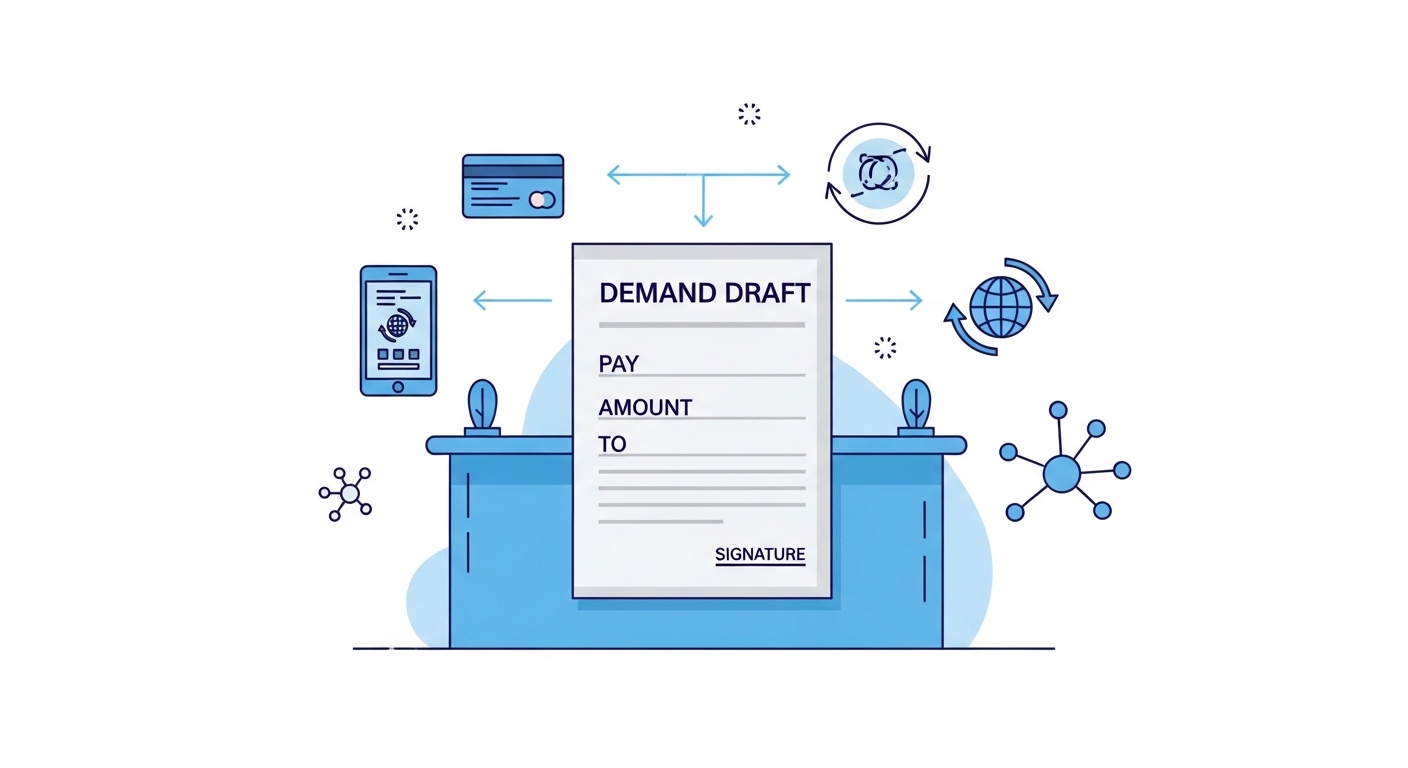
Digital payment transactions in India are projected to exceed 150 billion in 2026, showcasing a significant shift towards digital convenience across the nation. Despite this rapid adoption, there remain crucial situations where traditional, highly secure payment instruments like the Demand Draft (DD) are not just preferred but often mandatory. You’ll find that for specific high-value transactions or institutional payments, a DD offers a level of assurance that digital methods can’t always match.
Understanding how to obtain a Demand Draft, even if you don’t hold a bank account, is therefore incredibly valuable. It ensures you’re prepared for those moments when only a guaranteed payment will suffice, providing peace of mind for both the sender and the recipient. This traditional method continues to play a vital role in India’s diverse financial landscape, especially for those who might not be fully integrated into the digital banking system.
Table of Contents
What is a Demand Draft?
Understanding this payment method
A Demand Draft, commonly known as a DD, is a pre-paid negotiable instrument issued by a bank on behalf of a customer. It’s essentially a promise from the issuing bank to pay a specified sum of money to a named beneficiary. This makes it a highly reliable form of payment, as the funds are guaranteed by the bank itself.
You’ll find that the bank debits the amount from the purchaser at the time of issue, plus a small service charge. This ensures that when the DD is presented for payment, there are no issues with insufficient funds. It’s a payment method that prioritises certainty and security above all else.
How it differs from cheques
While both Demand Drafts and cheques are used for making payments, their fundamental nature is quite different. A cheque is an instruction to your bank to pay money from your account, and its payment is subject to you having enough funds in that account. If your account balance is low, the cheque can “bounce.”
A Demand Draft, however, is a bank’s own promise to pay, meaning the funds are already secured by the bank when the DD is issued. This eliminates the risk of non-payment due to insufficient funds, making it a more dependable option for the recipient. You’re effectively buying a guarantee from the bank.
Quick Context: Pay Order vs. Demand Draft
A “Pay Order” is similar to a Demand Draft but is typically used for local payments within the same city. A Demand Draft can be encashed at any branch of the issuing bank across India.
Why it is a secure payment
The inherent security of a Demand Draft comes from the fact that it’s a pre-funded instrument. The bank collects the payment upfront, guaranteeing the funds to the beneficiary. This removes the risk of a bounced payment, which is a common concern with personal cheques.
Furthermore, a DD is “account payee,” meaning it can only be credited to the bank account of the named beneficiary. This prevents fraudulent encashment by someone else, adding another layer of protection for you and the recipient. It’s a robust system designed to protect your money.
Why You Might Need a Demand Draft
Making large payments
For significant financial transactions, a Demand Draft often provides the necessary assurance that a personal cheque might lack. When you’re making a large payment, such as for property purchase, vehicle acquisition, or a substantial investment, the recipient usually prefers a DD. This is because they can be certain the funds will clear without any issues.
Imagine you’re paying a builder for a new flat; they’ll almost certainly ask for a DD to guarantee the payment. It simplifies the transaction for both parties, removing payment uncertainty. You’re giving them a bank’s assurance, not just your own.
Sending money safely
When sending money over a distance, especially to individuals or entities you might not know well, a DD offers a secure channel. Since the DD is made out to a specific person or institution and is account payee, the risk of it being intercepted and misused is significantly reduced. You don’t have to worry about cash being lost or stolen in transit.
This method is particularly useful when you need to send funds to someone in another city or state. The recipient can deposit it into their bank account without concerns about the payment’s authenticity. It’s a tried-and-tested way to ensure your money reaches its intended destination securely.
Payments to institutions
Many educational institutions, government bodies, and professional organisations still mandate payments via Demand Draft. This is often due to their internal accounting procedures and the need for guaranteed funds. For instance, when applying for college admissions, appearing for competitive exams, or submitting tender documents, you’ll frequently find a DD listed as the only acceptable payment method.
These institutions rely on the DD’s assured payment status to process applications and services efficiently. It simplifies their reconciliation process and reduces administrative overhead associated with managing potentially bounced cheques. You’re providing them with a payment that requires minimal verification.
Pro Tip: Always confirm the exact payee name for institutional payments.
Even a small spelling error in the beneficiary’s name can lead to your Demand Draft being rejected by the institution or their bank, causing delays and requiring reissuance. Double-check the official instructions.
Can You Obtain a Demand Draft Without a Bank Account?
Yes, it is possible
You might be surprised to learn that you can indeed obtain a Demand Draft even if you don’t have an account with the bank you approach. This is a crucial provision that ensures financial inclusivity and allows everyone access to this secure payment method. The Reserve Bank of India (RBI) has specific guidelines that facilitate this.
This flexibility is particularly helpful for individuals who primarily deal in cash or who may not have a regular banking relationship. It means you’re not excluded from making important payments that require a DD, simply because you don’t have an account. You just need to follow a slightly different process.
Specific bank policies
While the general rule is that non-account holders can get a DD, individual banks might have their own specific internal procedures or limits. Some banks might have a higher threshold for the amount you can request as a DD without an account, or they might require more stringent documentation. It’s always a good idea to check with the specific bank branch beforehand.
However, most banks are equipped to handle such requests, especially in major cities. You’ll find that the core requirements, such as identity and address proof, remain consistent across all banks. They are simply ensuring they meet regulatory standards.
Common Confusion: Needing a bank account
It is commonly assumed that you must have a bank account to get a Demand Draft
RBI guidelines allow individuals to obtain a DD up to Rs 50,000 in cash without needing an account, provided they present valid identification and address proof.
RBI guidelines for non-customers
According to the Reserve Bank of India (2026) guidelines, banks are permitted to issue Demand Drafts for amounts up to Rs 50,000 to non-account holders against cash payment. For amounts exceeding Rs 50,000, you would typically need to pay through a cheque or by debiting an existing bank account. This rule is in place to prevent money laundering and ensure financial transparency.
This threshold means that for most common institutional payments or smaller high-value transactions, you can easily obtain a DD with cash. The RBI’s framework ensures that while access is provided, necessary checks are also maintained. You’re contributing to a safer financial system.
Essential Documents You Will Need
When you approach a bank to get a Demand Draft as a non-account holder, you’ll need to provide certain documents to comply with Know Your Customer (KYC) norms. These requirements are in place to verify your identity and address, ensuring the transaction is legitimate. It’s a standard procedure designed for your security and the bank’s compliance.
Having all your documents ready before visiting the bank will help you complete the process quickly and efficiently. You’ll avoid unnecessary delays and multiple trips. This preparation is key to a smooth experience.
Valid photo identification
You’ll need to present an official document that clearly shows your photograph and verifies your identity. This is a fundamental KYC requirement for any financial transaction. The bank needs to confirm who you are.
Commonly accepted photo IDs include your Aadhaar card, Permanent Account Number (PAN) card, passport, driving licence, or Voter ID card. Make sure the document is current and not expired. You should carry the original for verification purposes.
Proof of your address
In addition to identity proof, you’ll also need to provide a document that confirms your current residential address. This helps the bank establish your physical location and is another critical part of the KYC process. It ensures transparency in financial dealings.
Accepted address proofs often include your Aadhaar card, driving licence, passport, utility bills (electricity, water, gas) not older than two months, or a bank statement. Ensure the address on your document matches your current residence. You might need to provide a copy along with the original for verification.
| Document Type | Examples of Accepted Documents | Key Information Verified |
| Photo ID | Aadhaar Card, PAN Card, Passport, Driving Licence | Your Identity, Photograph |
| Address Proof | Aadhaar Card, Passport, Utility Bill (recent), Bank Statement | Your Current Residential Address |
| PAN Card | PAN Card | Your Tax Identity (mandatory for transactions over Rs 50,000) |
Your Permanent Account Number (PAN)
For any Demand Draft transaction amounting to Rs 50,000 or more, providing your Permanent Account Number (PAN) is mandatory. This is a strict regulatory requirement by the Income Tax Department to track high-value financial transactions. It helps prevent money laundering and ensures tax compliance.
Even if the amount is less than Rs 50,000, it’s always a good practice to carry your PAN card. Some banks might request it as part of their internal policy, or you might need it for other related transactions. You’re demonstrating full transparency.
Other supporting documents
In some rare instances, depending on the bank’s internal policies or the specific nature of your transaction, you might be asked for additional documents. This could include a letter from the beneficiary requesting payment via DD, or proof of the source of funds for very large amounts. However, for most standard DD requests, the primary ID, address, and PAN are sufficient.
It’s wise to carry any documents that might seem relevant to your transaction, just in case. You’re better off being over-prepared than having to make another trip. Always inquire about specific requirements if you have any doubts.
The Step-by-Step Process for Non-Account Holders
Obtaining a Demand Draft without a bank account is a straightforward process, provided you have all the necessary documents and the required funds. Following these steps will help you complete the transaction smoothly. You’ll find that banks have a dedicated process for this.
This detailed guide ensures you know exactly what to expect at each stage. You’ll be able to navigate the process with confidence. It’s simpler than you might imagine.
Step 1: Visit a bank branch.
Choose any bank branch that is convenient for you, as most banks offer DD issuance services to non-account holders. It’s advisable to visit during non-peak hours to avoid long queues and ensure you have enough time to complete the formalities.
Step 2: Ask for a DD form.
Approach the customer service desk or the DD counter and request a Demand Draft application form for non-account holders. Clearly state that you do not have an account with their bank to ensure you receive the correct form.
Step 3: Fill in all details carefully.
The form will require you to provide your personal details, such as your full name, address, contact number, and your PAN. Ensure that all information is accurate and matches your supporting documents.
Step 4: Provide recipient information.
You’ll need to enter the full name of the beneficiary (the person or institution receiving the money) and the exact amount of the Demand Draft. Double-check the spelling of the beneficiary’s name and the amount to avoid any errors.
Step 5: Submit required documents.
Hand over the filled application form along with your original photo ID, address proof, and PAN card for verification. The bank official will verify your documents and might take photocopies.
Step 6: Pay the total amount.
Pay the Demand Draft amount in cash (up to Rs 50,000) along with the applicable bank charges and GST. For amounts exceeding Rs 50,000, you would typically need to pay via cheque or by debiting an account at another bank. Ensure you receive a payment receipt.
Step 7: Collect your Demand Draft.
Once the payment is processed and documents verified, the bank will issue the Demand Draft to you. Carefully check all the details on the DD, especially the beneficiary’s name, amount, and date, before leaving the counter.
Read More
How to approve UPI payment in Paytm?Where Can You Get a Demand Draft?
You can obtain a Demand Draft from almost any commercial bank operating in India. Both public sector and private sector banks offer this service to their customers and non-customers alike. This widespread availability makes it a convenient option for many.
However, it’s worth noting that some smaller co-operative banks or specific rural branches might have limitations. You should always confirm with your preferred branch if you have any doubts. Most major bank branches in urban and semi-urban areas will definitely be able to assist you.
Public sector banks
Major public sector banks like State Bank of India (SBI), Punjab National Bank (PNB), Bank of Baroda, and Canara Bank are well-equipped to issue Demand Drafts. They have extensive branch networks across the country, making them easily accessible. You’ll find their procedures are generally standardised.
These banks often handle a high volume of DD requests, especially for government-related payments or educational fees. You can rely on their established processes for a smooth transaction. They are a reliable choice for your DD needs.
Private sector banks
Leading private sector banks such as HDFC Bank, ICICI Bank, Axis Bank, and Kotak Mahindra Bank also readily provide Demand Draft services. These banks are known for their customer service and often have more modern facilities. You might find their waiting times to be shorter in some locations.
Their systems are typically efficient for processing DD requests, whether you’re an account holder or not. You’ll receive the same level of security and authenticity from a private bank DD. It’s about choosing convenience and reliability.
Designated bank branches
While most branches offer DD services, in very remote areas, some smaller branches might have specific timings or limitations for non-account holder transactions. It’s always best to call ahead or check the bank’s website for specific branch services. You want to ensure they can cater to your request.
For very large amounts, exceeding the cash limit, it’s advisable to visit a larger branch with a dedicated treasury or corporate banking desk. They are better equipped to handle such transactions. You’re ensuring a smoother process by choosing the right branch.
Understanding the Costs Involved
Obtaining a Demand Draft isn’t a free service; banks charge a fee for issuing it. These charges are typically a small percentage of the DD amount, with a minimum and maximum cap. You’ll need to factor this cost into your total payment.
It’s important to be aware of these charges beforehand to avoid any surprises. You’re paying for the bank’s guarantee and administrative services. This fee contributes to the security and reliability of the instrument.
Bank service charges
Each bank sets its own schedule of charges for issuing Demand Drafts. These fees generally depend on the amount of the DD.
For instance, a bank might charge Rs 50 for a DD up to Rs 10,000, and then a percentage (e.g., 0.15%) for amounts above that, subject to a maximum fee. You should always check the bank’s official website or inquire at the branch for their current fee structure.
These charges are non-negotiable and are applied uniformly to all customers, whether you have an account or not. You are essentially purchasing a financial service. The fee ensures the bank covers its operational costs.
Varies by bank
The service charges for Demand Drafts can vary significantly from one bank to another. Public sector banks might have slightly lower charges compared to some private sector banks, but this isn’t always the case. It’s a good idea to compare the charges of a few banks if you have the time and options.
However, for most people, the convenience of the nearest branch often outweighs minor differences in fees. You’ll find that the difference usually isn’t substantial enough to warrant travelling a long distance. Your priority is often getting the DD issued quickly.
Common Confusion: Hidden charges
The misunderstanding here is that banks might add hidden charges to Demand Drafts
All bank charges for DD issuance are clearly listed in their schedule of charges and must be disclosed upfront. There are no hidden fees beyond the stated service charge and GST.
Additional GST applicable
In addition to the bank’s service charge, you will also be required to pay Goods and Services Tax (GST) on the service fee. As of 2026, the standard GST rate for financial services is 18%. This tax is mandated by the government and is added to the bank’s fee.
So, if a bank’s service charge is Rs 100, you would pay Rs 100 + 18% GST (Rs 18), making the total service cost Rs 118. You’re complying with government tax regulations. This is a standard practice for most services in India.
| DD Amount Range | Typical Service Charge (Example) | Applicable GST (18%) | Total Cost |
| Up to Rs 5,000 | Rs 25 | Rs 4.50 | Rs 29.50 |
| Rs 5,001 to Rs 10,000 | Rs 50 | Rs 9.00 | Rs 59.00 |
| Rs 10,001 to Rs 50,000 | Rs 0.15% of DD amount (min Rs 75) | 18% on service charge | Service Charge + GST |
| Above Rs 50,000 | Rs 0.10% of DD amount (min Rs 100) | 18% on service charge | Service Charge + GST |
Note: These are example charges for illustration purposes. Actual charges may vary by bank and are subject to change.
Important Points to Remember
Once you have your Demand Draft, there are several important things you should keep in mind to ensure its safe and effective use. These tips will help you manage your DD responsibly. You’re protecting your financial transaction.
Understanding these aspects can save you from potential headaches later on. You’re taking proactive steps to safeguard your payment. It’s about being an informed user.
Check details carefully
Before you leave the bank counter, always take a moment to thoroughly check all the details printed on the Demand Draft. Verify the beneficiary’s name, the amount, the date of issue, and the issuing bank’s details. A single error can lead to the DD being rejected by the recipient’s bank.
If you spot any discrepancies, immediately bring them to the attention of the bank official for correction. You’re ensuring the DD is perfect before it leaves the bank. This simple check can prevent significant delays.
Keep your payment receipt
The bank will provide you with a payment receipt for the Demand Draft and the charges paid. This receipt is a crucial document and you should keep it safe. It serves as proof of your transaction and will be essential if you need to track, cancel, or re-issue the DD.
Without this receipt, resolving any issues with the DD can become much more complicated. You’re maintaining a record of your payment. It’s your primary evidence of the transaction.
Validity period of DD
A Demand Draft typically has a validity period of three months from its date of issue. This means the beneficiary must present it for payment within this timeframe. After three months, the DD becomes stale and cannot be encashed without revalidation.
If a DD expires, you or the beneficiary will need to approach the issuing bank to revalidate it, which might involve a small fee. You should inform the beneficiary about this validity period. It’s important to act promptly.
Pro Tip: Always send your DD via a reliable courier with tracking.
For important Demand Drafts, use a reputable postal or courier service that provides a tracking number. This allows you to monitor its delivery status and ensures it reaches the beneficiary safely.
What if DD is lost?
Losing a Demand Draft can be a stressful situation, but it’s not the end of the world. If you lose the DD before sending it, or if it gets lost in transit, you should immediately inform the issuing bank. You will need to provide the DD number, date of issue, amount, and beneficiary details.
The bank will then initiate a stop payment process. You’ll also need to submit an indemnity bond, undertaking responsibility if the original DD is found and encashed fraudulently. You’re taking immediate action to prevent misuse.
Cancellation and reissuance
If you need to cancel a Demand Draft, you can do so at the issuing bank branch. You’ll need to present the original DD (if you still have it) and your payment receipt. The bank will cancel the DD and refund the amount, usually after deducting a small cancellation charge.
If the DD was lost and a stop payment was placed, the bank can issue a fresh DD or refund the amount after a waiting period, once they are certain the original DD hasn’t been encashed. You’re able to rectify situations if plans change. This flexibility is important for users.
When Should You NOT Use a Demand Draft?
While Demand Drafts offer unparalleled security for certain transactions, they are not always the most efficient or suitable payment method. Understanding when to choose an alternative can save you time and money. You need to consider the context of your payment.
This awareness helps you make informed decisions about your financial transactions. You’re selecting the best tool for the job. It’s about efficiency and convenience.
- For small amounts: The service charges for a DD, even for small sums, can sometimes be disproportionately high compared to the amount being paid. For instance, paying Rs 1,000 with a DD might incur a fee of Rs 50, which is 5% of the amount.
- For urgent transfers: Issuing a DD involves a physical visit to the bank and processing time, which can take an hour or more. If you need to send money instantly, digital payment methods are far superior.
- When flexibility is needed: Once a DD is issued, changing the beneficiary or amount requires cancellation and reissuance, which is a cumbersome process. Digital transfers offer more flexibility for modifications before final execution.
- For international payments: Demand Drafts are primarily for domestic transactions within India. For sending money abroad, you would need to explore international wire transfers or other foreign exchange services.
- If the beneficiary prefers digital: Many recipients, especially younger individuals or businesses, prefer instant digital payments like UPI or bank transfers. Always confirm the recipient’s preferred method before getting a DD.
Alternative Secure Payment Methods
In today’s digital age, you have several other secure options for sending money, especially if a Demand Draft isn’t the most suitable choice. These alternatives often offer greater speed and convenience. You’re not limited to just one method.
Exploring these options can help you find the most efficient way to manage your payments. You’ll discover methods that fit various needs. It’s about having choices.
Bank transfers (NEFT/RTGS)
For electronic fund transfers from one bank account to another within India, you can use NEFT (National Electronic Funds Transfer) or RTGS (Real Time Gross Settlement). NEFT is suitable for amounts under Rs 2 lakh and processes transactions in batches, while RTGS is for high-value transactions (Rs 2 lakh and above) and processes them individually and continuously. Both are highly secure and regulated by RBI.
These methods require you to have a bank account and the beneficiary’s account details. You can initiate these transfers online via net banking or mobile banking, or by visiting your bank branch. They offer speed and traceability.
Electronic funds transfer
Beyond NEFT and RTGS, other electronic fund transfer options include UPI (Unified Payments Interface) for instant, small-to-medium value payments. While UPI is usually linked to a bank account, many banks offer services where you can load funds and send money even without a full-fledged account. These are incredibly convenient for day-to-day transactions.
You’ll find that these digital methods are often free or incur very minimal charges, making them cost-effective for frequent use. They offer a level of immediacy that traditional methods can’t match. You’re using technology to your advantage.
Pre-paid instruments (general term)
Pre-paid instruments (PPIs) are another category of secure payment methods. These include pre-paid cards or mobile wallets where you load money in advance and then use it for various transactions. While often linked to a basic KYC process, they can provide a secure way to manage spending without a traditional bank account.
You can use these for online shopping, utility bill payments, and even some merchant payments. They offer a degree of control over your spending and can be a good alternative for specific needs. It’s like having a digital cash wallet.
| Payment Method | Speed | Account Required | Max Amount (Typical) | Key Benefit |
| Demand Draft (DD) | Slow (physical delivery) | No (up to Rs 50K cash) | No official limit | Bank-guaranteed payment |
| NEFT | Batches (few hours) | Yes | No limit | Secure, traceable electronic transfer |
| RTGS | Real-time | Yes | No limit (min Rs 2 lakh) | Instant high-value electronic transfer |
| UPI | Instant | Yes (linked to account) | Rs 1 lakh/day | Instant, convenient mobile payments |
Conclusion
Getting a Demand Draft without a bank account is a perfectly viable option, offering you a secure and guaranteed payment method for crucial transactions. By understanding the required documents and following the step-by-step process, you can confidently obtain a DD for institutional fees or large payments. Always remember to carefully verify all details on the draft and keep your payment receipt safe, as this ensures you can track or manage it effectively if needed.
Author
