

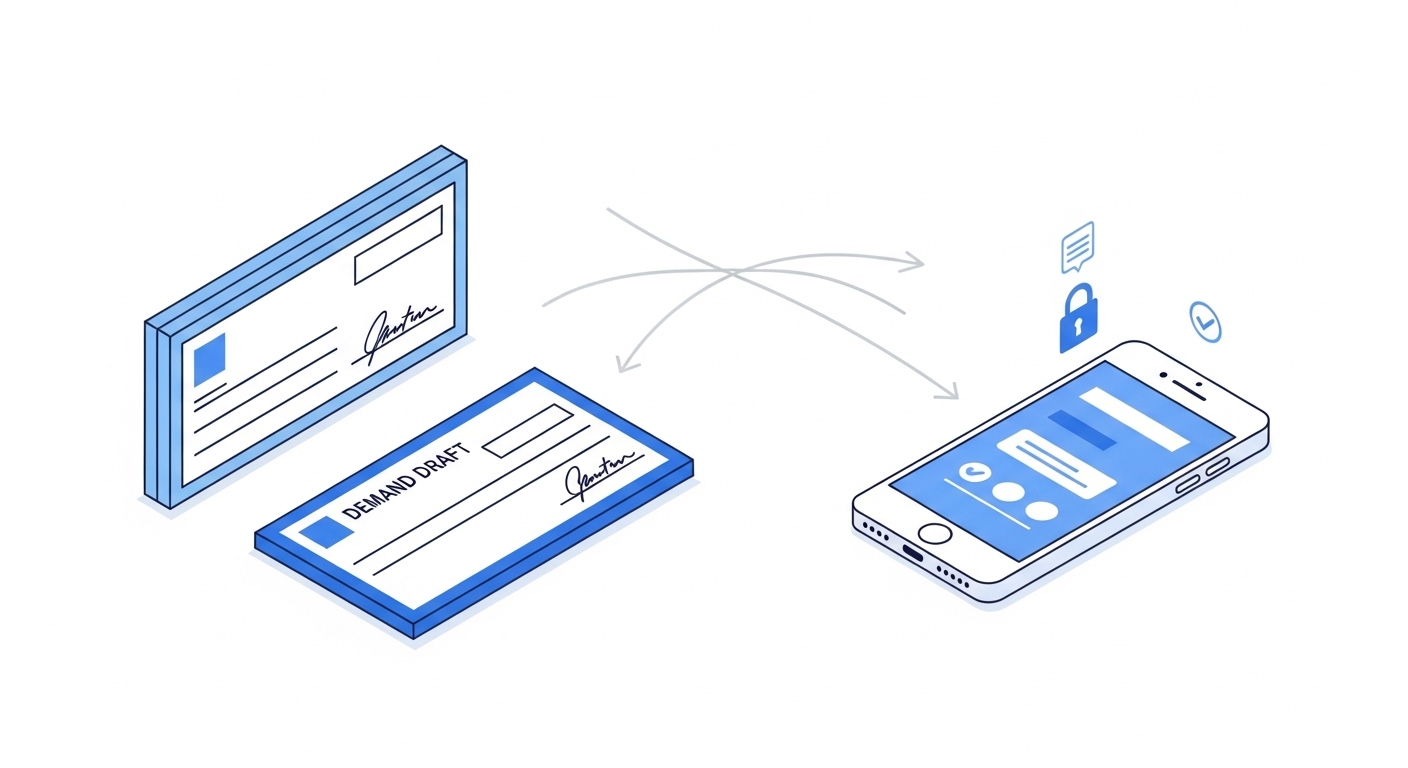
Choosing the right way to send money, especially for large amounts, is a bit like picking the best tool for a big construction job. You wouldn’t use a tiny screwdriver for a major structural bolt, just as you wouldn’t use a fragile instrument for heavy lifting. Each payment method has its own strengths and weaknesses, designed for specific situations to ensure your funds reach their destination safely and efficiently.
Understanding these options – whether it’s a Demand Draft, a Cheque, or NEFT – helps you build a strong financial foundation. You need to know which tool offers the most security, speed, or convenience for your particular need, especially when dealing with significant sums in India. Making the wrong choice could lead to delays, extra costs, or even security risks.
Table of Contents
Understanding Your Payment Choices
When you’re dealing with substantial sums of money, like paying for a property down payment, a child’s university fees, or a large business transaction, the method you choose for payment becomes critically important. These aren’t just everyday expenses; they often involve considerable trust and financial commitment. You need a payment system that offers reliability and peace of mind.
India’s financial landscape provides several established methods for handling these larger transactions, each with its own set of rules, benefits, and potential drawbacks. Knowing the differences between them helps you make an informed decision that suits your specific requirements and those of the recipient. It’s about ensuring your funds move securely and efficiently.
Why Large Transactions Matter
Large transactions carry inherent risks, from potential fraud to delays that could have significant financial implications. For instance, missing a property registration deadline due to a bounced cheque could lead to penalties or even the loss of a deal. This is why the security and certainty of your chosen payment method are paramount.
The regulatory environment, particularly guidelines from the Reserve Bank of India (RBI), often imposes specific requirements or limits on these larger transfers. As of 2026, many transactions above Rs 50,000, for example, might require additional verification or fall under specific reporting mandates, making your choice even more crucial.
Exploring Different Methods
You have three primary methods available for significant financial transfers: the Demand Draft, the Cheque, and the National Electronic Funds Transfer (NEFT). Each one operates on a distinct principle and offers varying levels of speed, security, and convenience. Your decision will depend on balancing these factors.
We’ll explore each method in detail, helping you understand how they work, their advantages, and when they are best used. This knowledge will equip you to confidently handle your large payments, whether you’re sending money across the city or across the country.
Quick Context: Large Transactions
What qualifies as a large transaction often depends on your bank and the context, but generally, amounts over Rs 50,000 are considered significant and might trigger specific reporting requirements by financial institutions in 2026.
What Is a Demand Draft?
A Demand Draft, often shortened to DD, is a payment instrument issued by a bank on behalf of a customer, directing another branch of the same bank or another bank to pay a specific sum of money to a named person or entity. It’s essentially a pre-paid, bank-guaranteed payment. You give the bank the money first, and then the bank issues the draft.
This means that a Demand Draft cannot “bounce” because the funds are already secured by the issuing bank. This inherent guarantee makes it a highly trusted method for large transactions where the recipient needs absolute certainty of payment. It eliminates the risk of insufficient funds, which is a common concern with personal cheques.
Bank-Guaranteed Payment Method
The primary advantage of a Demand Draft is the bank’s guarantee. When you purchase a DD, your bank debits your account immediately, or you pay in cash, and then issues the draft.
This guarantee is why Demand Drafts are often required for crucial payments like university admissions, property purchases, or government tenders. You’re not just promising to pay; the bank itself is promising to pay on your behalf, making it a very secure instrument.
How Demand Drafts Work
Applying for a Demand Draft is a straightforward process, though it requires a visit to your bank branch. You’ll need to provide specific details about the payment and the recipient.
Step 1: Visit your bank branch and fill out a Demand Draft application form, providing the exact amount, the beneficiary’s name, and the city where the DD will be payable.
Step 2: Pay the amount of the DD plus any applicable issuance fees, either by debiting your account or paying in cash, and the bank will then process your request.
Step 3: Collect the Demand Draft from the bank, which will contain details like the amount, beneficiary name, and the issuing bank’s signature, making it ready for physical delivery to the recipient.
Key Features to Know
Demand Drafts are generally valid for three months from the date of issue, similar to cheques. After this period, they become stale and need revalidation or reissuance by the bank. You should always ensure the recipient encashes it promptly.
They are also “account payee” by default, meaning the funds can only be credited to the account of the named beneficiary, further enhancing their security. This prevents anyone else from fraudulently cashing the draft.
Common Confusion: DD and Cheque Difference
It is commonly assumed that a Demand Draft is just like a cheque, but issued by a bank
A Demand Draft is a bank’s promise to pay, guaranteeing funds, while a cheque is your instruction to your bank, subject to your account balance, meaning it can bounce.
Exploring the Cheque System
A cheque is a traditional payment instrument where you, the account holder, instruct your bank to pay a specific amount of money from your account to the person or entity named on the cheque. It’s essentially a written order that authorises a transfer of funds. Unlike a Demand Draft, a cheque’s validity depends on you having sufficient funds in your account at the time it’s presented for payment.
The cheque system has been a cornerstone of financial transactions for decades, offering a simple and widely accepted method for making payments. While digital alternatives are gaining popularity, cheques still hold relevance for many individuals and businesses in India, particularly for recurring payments or when a physical record is preferred.
Your Instruction to Bank
When you issue a cheque, you’re giving a direct instruction to your bank. Your bank will “honour” this instruction by transferring the specified amount from your account to the payee’s account, provided your account has enough funds. If there aren’t sufficient funds, the cheque will “bounce,” leading to penalties for you and inconvenience for the recipient.
This reliance on your account balance is the key difference from a Demand Draft. You bear the responsibility of ensuring funds are available when the cheque is presented.
Different Cheque Types
You’ll encounter a few types of cheques, each with slightly different implications. A “bearer cheque” can be encashed by anyone who presents it at the bank, making it less secure. An “order cheque” can only be paid to the named payee or someone they endorse it to.
Most commonly, you’ll use a “crossed cheque,” which has two parallel lines drawn across its face, often with “Account Payee Only” written between them. This ensures the funds are deposited directly into the payee’s bank account, preventing cash withdrawals and enhancing security.
Pro Tip: Crossing Your Cheque
Always cross your cheques with “Account Payee Only” to ensure the funds are deposited directly into the recipient’s bank account, preventing theft or misuse and providing a clear audit trail.
How Cheques Are Used
Using a cheque involves a few simple steps, but precision is key. Any errors can lead to delays or the cheque being returned unpaid.
- Write the date accurately, ensuring it’s within the validity period (three months from issue in 2026).
- Clearly write the payee’s name, the amount in both words and figures, and ensure they match exactly to avoid discrepancies.
- Sign the cheque exactly as your signature is registered with the bank, as any mismatch can cause it to be dishonoured.
- Keep a record of the cheque number, amount, date, and payee in your chequebook counterfoil for your own financial tracking.
Understanding NEFT: Digital Transfers
NEFT, or National Electronic Funds Transfer, is an electronic payment system that allows you to transfer funds from your bank account to another individual or entity’s bank account across India. It’s a digital revolution in payments, moving money directly between bank accounts without the need for physical instruments like cheques or Demand Drafts. This system operates on a deferred net settlement basis, meaning transactions are processed in batches.
Since its inception, NEFT has become incredibly popular due to its speed, convenience, and low cost. It’s a system managed by the Reserve Bank of India, ensuring a secure and reliable framework for digital money movement. You can initiate NEFT transfers from the comfort of your home or office using internet banking or mobile banking apps.
Electronic Fund Movement
NEFT represents a significant shift from paper-based transactions to a fully digital environment. Instead of physically carrying a cheque or DD, you simply provide the recipient’s bank account details and initiate the transfer electronically. This not only saves time but also reduces the risks associated with handling physical cash or paper instruments.
The system is designed for broad accessibility, allowing transfers between any NEFT-enabled bank branches across the country. This wide reach makes it an ideal choice for inter-city or even inter-state payments, facilitating quick and efficient financial interactions.
How NEFT Works
Initiating an NEFT transfer is a straightforward digital process that most banks have integrated into their online platforms. You’ll need the recipient’s bank details to get started.
Step 1: Log in to your internet banking portal or mobile banking app and navigate to the “Funds Transfer” or “Payments” section.
Step 2: Add the beneficiary by providing their name, account number, account type, and the Indian Financial System Code (IFSC) of their bank branch, then wait for your bank’s cooling-off period if applicable.
Step 3: Select the beneficiary, enter the amount you wish to transfer, confirm the details, and authorise the transaction using your password or PIN, after which you’ll receive a transaction reference number.
NEFT Timings and Limits
One of the most significant advantages of NEFT is its 24×7 availability. The system operates round the clock, every day of the year, including weekends and holidays, since December 2019. This means you can initiate a transfer at any time, and it will be processed in the next available batch.
While the Reserve Bank of India (RBI) does not impose a minimum or maximum limit on the amount that can be transferred through NEFT for individuals, individual banks may set their own per-transaction limits, often around Rs 50,000 to Rs 10 lakh for online transfers in 2026. However, there’s no overall daily limit from RBI for individuals.
Quick Context: NEFT 24×7
The National Electronic Funds Transfer (NEFT) system has been available 24 hours a day, 7 days a week, including holidays, since December 2019, making it highly convenient for digital transfers at any time.
Read More
How to approve UPI payment in Paytm?Comparing Demand Drafts, Cheques, and NEFT
Choosing between a Demand Draft, a Cheque, and NEFT for large transactions requires a careful comparison of their key attributes. Each method offers a different balance of security, speed, cost, and convenience, making one more suitable than the others depending on your specific situation. You need to weigh these factors against your priorities for each payment.
Let’s look at how these three popular payment methods stack up against each other. Understanding these differences will empower you to make an informed choice for your next significant financial transfer.
Safety and Security
Demand Drafts are considered highly secure because they are bank-guaranteed; the funds are already with the bank, so there’s no risk of bouncing. NEFT transactions are also very secure, being fully digital and traceable, with multiple layers of encryption and authentication protecting your money. Cheques, while generally safe when used correctly, carry the risk of bouncing if funds are insufficient, and can be more susceptible to fraud if not handled carefully (e.g., lost or stolen).
Speed of Transaction
NEFT is by far the fastest option, with funds typically credited to the recipient’s account within a few minutes to a few hours, thanks to its 24×7 processing. Demand Drafts involve physical delivery, which can take days, plus the time for the recipient to deposit and the bank to process. Cheques also require physical delivery, and bank clearing cycles can take 2-3 working days, or even longer if it’s an outstation cheque.
Costs and Fees Involved
Issuing a Demand Draft usually incurs a small fee, which varies by bank and the amount of the draft. Cheques generally have a nominal cost per leaf, but bounced cheques can lead to significant penalty charges for the drawer. NEFT transfers are often free for online transactions with many banks in 2026, or incur very minimal charges, making them a cost-effective choice.
Ease of Use
NEFT is the most convenient method, as you can initiate transfers online or via mobile banking from anywhere, anytime. Demand Drafts require a visit to a bank branch to apply for and collect the physical instrument. Cheques also require a physical instrument, which you write out, and the recipient must physically deposit it.
Information You Need
For a Demand Draft, you typically need the beneficiary’s name and the city where the DD will be payable. For a cheque, you only need the beneficiary’s name.
NEFT requires the most detailed information: the beneficiary’s name, bank account number, account type, and their bank branch’s IFSC code. This extra detail helps ensure the funds reach the correct account digitally.
| Feature | Demand Draft | Cheque | NEFT |
| Security | Bank-guaranteed, very high | Moderate (risk of bounce) | High (digital, traceable) |
| Speed | Slow (physical delivery + clearing) | Slow (physical delivery + clearing) | Fast (near real-time, 24×7) |
| Cost | Moderate issuance fee | Low (leaf cost), high for bounce | Low to free (online) |
| Convenience | Low (bank visit required) | Moderate (physical instrument) | High (online/mobile 24×7) |
| Information Needed | Beneficiary name, payable city | Beneficiary name | Beneficiary name, A/C number, IFSC |
Common Confusion: NEFT Transaction Limits
Users often search about specific daily limits for NEFT transactions, thinking it’s capped like UPI
While individual banks might set per-transaction limits (e.g., Rs 50,000 for some online NEFTs), the Reserve Bank of India does not impose an overall daily limit on the total amount you can transfer via NEFT.
When to Choose Each Method
Your choice of payment method should always align with the specific requirements of your transaction. There isn’t a single “best” option; instead, it’s about identifying which method is most suitable for the circumstances you face. Considering the context helps you make a strategic decision.
Think about the urgency of the payment, the recipient’s preference, and your own comfort with digital versus physical instruments. Each method excels in different scenarios, making them valuable tools in your financial toolkit.
Best for High Value
For very high-value transactions where the recipient absolutely needs guaranteed funds, a Demand Draft is often the preferred choice. Examples include securing a property deal or paying a large security deposit where the certainty of payment is non-negotiable. The bank’s backing provides unmatched assurance.
However, if speed is also a critical factor for a high-value transfer, NEFT can also be an excellent option, provided the recipient’s bank allows for quick credit of large sums. Always confirm the recipient’s bank policies for large digital receipts.
Best for General Use
For routine payments, especially those to known parties where a physical record is handy, cheques remain a popular choice. They are useful for paying rent, school fees, or local vendors. You have control over when the cheque is presented, giving you time to ensure funds are available.
For most other general payments, particularly if you value convenience and speed, NEFT is often the superior option. It’s ideal for paying utility bills, transferring money to family, or making online purchases.
Best for Fast Transfers
Without a doubt, NEFT is the champion for fast transfers. If you need money to reach an account quickly, whether it’s an urgent business payment or helping a family member in need, NEFT’s 24×7 processing ensures the funds move almost instantly. There’s no waiting for physical delivery or clearing cycles.
This speed is particularly beneficial in today’s fast-paced digital economy, where delays can sometimes mean missed opportunities. You can execute a transfer and receive confirmation within minutes, providing immediate peace of mind.
When You Need Proof
All three methods provide a record of your transaction, which is essential for accounting and dispute resolution. With a Demand Draft, you’ll have the counterfoil from the bank. For cheques, your chequebook counterfoil serves as proof, and your bank statement shows the debit.
NEFT provides a digital transaction ID and a digital receipt, which can be easily downloaded and stored. This digital trail is often the most convenient for record-keeping and can be quickly retrieved if needed.
Pro Tip: Always Confirm
Before initiating any large transaction, especially via NEFT, always confirm the recipient’s bank account number and IFSC code verbally or through a trusted channel to prevent misdirection of funds; a single digit error can send your money to the wrong account.
Important Things to Remember
Regardless of the payment method you choose, certain best practices can help you ensure your transactions are smooth, secure, and error-free. Overlooking these details can lead to significant headaches and potential financial losses. You should always approach large transactions with diligence and care.
Being proactive about verification and record-keeping protects your interests and fosters trust in your financial dealings. These are universal principles that apply across all payment types.
Verifying Recipient Details
This is perhaps the most critical step for any transaction, especially for NEFT. A single incorrect digit in an account number or IFSC code can lead to your funds being transferred to the wrong person. Always double-check, and if possible, triple-check, the beneficiary’s details before authorising a transfer.
For physical instruments like Demand Drafts and cheques, ensure the spelling of the beneficiary’s name is absolutely correct. Any discrepancies can cause delays or even refusal of payment by the bank.
Keeping Records Safe
Always maintain a meticulous record of all your large transactions. For Demand Drafts, keep the counterfoil safely.
For cheques, ensure your chequebook counterfoils are filled out completely and stored securely. For NEFT, download and save the transaction confirmation receipts.
These records serve as vital proof of payment in case of any dispute or for your tax filing purposes. They provide an audit trail that can be invaluable years down the line.
Understanding Bank Rules
Each bank may have specific internal policies regarding transaction limits, processing times, or fees, even within the broader RBI guidelines. For instance, while RBI doesn’t set a daily NEFT limit, your bank might have a per-transaction cap for online transfers. It’s wise to familiarise yourself with your bank’s specific terms and conditions.
You can usually find this information on your bank’s website or by contacting their customer service. Understanding these nuances helps you avoid unexpected issues or delays.
Common Confusion: Cheque Validity
A widespread myth is that a cheque remains valid indefinitely until it is cancelled or the account is closed
In India, cheques are typically valid for three months from the date of issue, after which they become “stale” and cannot be encashed without revalidation from the drawer.
Making Your Best Payment Choice
Selecting the ideal payment method for a large transaction doesn’t have to be complicated. By systematically evaluating your needs and the characteristics of each option, you can confidently make a choice that is both efficient and secure. This careful consideration protects your finances and ensures smooth execution.
Ultimately, the best payment method is the one that aligns perfectly with your specific situation, offering the right balance of speed, security, and convenience for you and your recipient. You’re in control of this important decision.
Considering Your Needs
Start by asking yourself what your top priority is. Is it absolute certainty of payment, even if it means a slight delay?
Then a Demand Draft might be best. Do you need the money to reach the recipient as quickly as possible?
NEFT is your answer. Are you making a regular payment to a trusted party where a physical record is preferred?
A cheque could work.
Think about the amount involved, the urgency, and your personal comfort level with digital versus paper-based transactions. Your individual circumstances should guide your decision-making process.
Thinking About the Recipient
Consider the recipient’s preferences and capabilities. Do they have easy access to a bank branch to deposit a Demand Draft or cheque?
Are they comfortable with digital transactions and have their bank account details readily available for NEFT? Sometimes, the most convenient option for you might not be the most convenient for them.
Communicating with the recipient beforehand can help you both agree on the most suitable payment method, preventing any misunderstandings or delays. This collaborative approach fosters smoother transactions.
Staying Secure Online
If you opt for NEFT, remember that online security is paramount. Always ensure you are using a secure internet connection and that your device is free from malware.
Never share your banking passwords or PINs with anyone. These practices safeguard your digital transactions.
Regularly review your bank statements to spot any unauthorised activity quickly. Staying vigilant online is your best defense against potential cyber threats in 2026.
Quick Context: Financial Literacy
Understanding different payment methods is a key part of financial literacy, helping you manage your money safely and efficiently for various needs, from personal expenses to large business dealings.
Conclusion
Choosing between a Demand Draft, Cheque, and NEFT for large transactions requires you to weigh security, speed, and convenience against your specific needs. For immediate and secure digital transfers, NEFT stands out as the most efficient option, ensuring funds reach the recipient quickly without physical handling. You should always verify recipient details meticulously, especially for NEFT, to prevent any misdirection of funds.
By understanding the bank’s guarantee with a Demand Draft, the instruction-based nature of a cheque, and the 24×7 digital speed of NEFT, you can confidently select the method that best safeguards your finances. Opting for NEFT for its speed and traceability helps you manage crucial payments effectively, ensuring your money arrives safely and on time.
How to send money to bank account through Paytm
Author
